Tuesday, August 16, 2011

BORN TO RUN by Christopher McDougall

Amidst all my other activities, I continue to try and work out, lose weight and get in shape. One of the things I have been trying to do is run more. The idea of lugging my carcass around for any distance is a little concerning because of the amount of force being put on my joints, particularly my knees. How to run without putting strain on my knees?

After looking around a bit, I decided I'd give barefoot running a shot. There are some folks out there who think that the footwear that Nike et al provide us actually do more harm than good - that we didn't have to worry about overpronation and crap like that until the shoe companies started making shoes for it. The idea is that running is natural and our foot is meant to move a given way (more ball of the foot oriented) and less the way shoes force us to (heel to toe). So I gave it a shot. And I found that running barefoot is a lot less jarring.

When I do run, I run on pavement and so the heat tsunami a few weeks ago made me a little too toasty for getting out and running barefoot. Nonetheless, I was pretty jazzed to find that I might be able to get back into running (I ran track and cross country in high school and was a biathlete in college. Of course that was tens of years and pounds ago).

In my excitement, JJ suggested that I read the book Born to Run. It was a very popular book in this area about a year or two ago and I knew that a fleet of women runners that work out at the local Y had all read it (it may also have been a book club book). Sue overheard our conversation and she recommended it too. Our copy was out so I drove to a nearby library and grabbed their copy. The librarian there told me that she wasn't a runner, wasn't interested in running, and she loved it. I don't think it could have come any more recommended.

All the recommendations were right. I loved it.

Right off the bat I knew I would I enjoy it. The author, Christopher McDougall, is my size, lives in rural, Amish Pennsylvania and the book opens with him trying to get himself into shape by running. Just like me! When he suffers an injury while running, he begins to explore alternatives. McDougall discovers a reclusive tribe of Indians in Mexico called the Taramuhara who are considered by many to be the best long-distance runners in the world. He begins to research them and finds that not only are they great runners, they love running, tend to be injury free, run in the barest of footwear and have a mostly vegetarian diet.

Along the way, McDougall encounters a bunch of interesting folk, ranging from drug dealers to ultra-marathoners to an American who picked up and moved to Mexico to live near the Taramuhara. In the end, a race is arranged between the Taramuhara and some of the top ultra-marathoners in the world with McDougall, big carcass and all, joining them and completing it.

It's a great book and a great story. Like the one librarian said, even if you aren't interested in running, it is fascinating and entertaining. If you are interested in running, it will help you look at and question some of the beliefs you may have held to be true.

--Jon

Sunday, August 14, 2011

THE WAY THROUGH DOORS by Jesse Ball


The Way Through Doors was an interesting piece of meta-fiction. The main character, Selah Morse, is a struggling pamphleteer who is hired by his uncle to work in some sort of odd secret governmental organization. One day he is out in the street walking and a beautiful woman races out of a building into the street where she is struck by a taxicab. Morse accompanies her to the hospital where he claims to be the woman's boyfriend. The woman has amnesia and cannot remember anything of her life. Morse takes her back to his place and begins to try and recreate her memories by telling her a story.

As his story progresses, characters within his story begin telling stories of their own and then characters in those stories tell their own stories. Some of those stories reference people from the previous stories but not always in ways that were expected. One story, for example, is an almost identical recreation of the first pages of the novel but with some minor twists. Along the way there are a number of interesting characters, the most prevalent being a Coney Island boardwalk mindreader who is wrong more often than he is right.

All in all, I liked it. There didn't seem to be much of a point to it all outside of the oddball style but it was fun. The author barely constrains himself when it comes to realism but although it is imaginative, it is not outlandishly so. I could see a re-read being beneficial to try and catch more details and such and the book is short enough to do so. Worth checking out if you want something different.

--Jon

Friday, August 12, 2011

A PASSION FOR BOOKS by Harold Rabinowitz


It took me a long time to read this book. It wasn't because the book was tedious. I really enjoyed it. It's because the book had to be savored. A Passion for Books is a collection of essays from noted figures in the book collecting world (which by default contains noted figures in the bookselling, writing and publishing worlds). There were some by favorites of mine like Nicholas Basbanes, Christopher Morley and Robertson Davies. There was one by the legendary A.S.W. Rosenbach. Umberto Eco, John Updike, Gustave Flaubert and many more. A veritable who's who.

As with any collection of work by a multitude of people, particularly one such as this where the entries ranged in length from a couple paragraphs to many pages, it is uneven. There were some really dull pieces interspersed with some really wonderful ones. There's also some lists of books and some cartoons.

I can see myself going back to this book, leafing through it, maybe even referencing it if the need arose. It's not one that I would read from cover to cover but some of the essays I liked a lot I would reread. If you're a book lover, you need to at least leaf through a copy.

--Jon

ELEVEN by Mark Watson


I read Eleven simply because Jon pulled it off the new book shelf and said it was a good read. I didn’t ask him what was good about it, but took his recommendation. This is odd, because I don’t always like what he likes. But for some reason, I keep reading his suggestions...

The premise is interesting and I liked right away what I read on the back about the author. He’s a comedian. And one of his other books is called A Light-Hearted Look at Murder – what a great title!

Eleven is about Xavier Ireland, a late-night radio talk show host, who has run away from his old life. He gives advice to the listeners of his call-in advice show, but yet deliberately avoids interfering in the lives of the people around him. Though written by a comedian, the story is not funny. Xavier is a lonely man who tries to avoid dealing with a very tough situation from a few years back (which is why he ran). A romantic interest comes along and calls him out on his selfishness, his inability to get involved with others. As is the case in many books and movies (and life?), the romantic attraction is the impetus for change.

My book club friends often tell of books making them cry. I don’t remember a book causing tears. This one came very close. When I read, mid-book, exactly what Xavier did that was so awful he felt it necessary to move to a different country and change his name I gasped out loud and then went several hours through the night with no sleep. Shudder. And another part of the story which hit very close to home drew my emotions a bit too close to the edge for my liking.

A blurb on the cover states: “One Moment Eleven Lives Endless Consequences.” One action (or inaction) by Xavier trickled down into drastic effects for others. A good reminder that our actions affect others (a scary thought or an empowering one? Depends upon your perspective, I suppose).

The ending was not what I thought was coming, but it was appropriate and interesting. The story is poignant, for sure. The writing is what I like – to the point, easy to follow, and not too poetic or contrived. I wonder what Jon will write about this one.

I rate it five stars.

JJ

My rating system:
1 star – Yawn or horrible writing
2 stars – Ick but slightly higher than horrible and boring
3 stars – Respect the author but it’s just not my thing
4 stars – Like the book but didn’t obsess about it
5 stars – Thought about the book day and night during the time I read it, hated for it to end, told anyone who would listen about the book I was reading

Wednesday, August 10, 2011

HOW TO SELL by Clancy Martin


I looked for How to Sell after reading the first part of this three part article in the Paris Review by Martin. From reading the article and then seeing the title of the book, I expected the book to be non-fiction but it is a novel. However, given Martin's background in the jewelry business and the fact that the story takes place in Texas where the narrator works with his brother in the jewelry business (as Martin did and lived), it's not a stretch to make the assumption that a good portion of the story is grounded in reality.

As such, I will never buy jewelry again. I know, it's hard to imagine me without my bling, but it's just not going to happen. Insane markups, selling customers' items that are brought in for cleaning and then telling the customer they were lost when they were shipped out, forgery, outright lying. It's a pretty shady business. And what do you expect? A lot of characters have drug habits that need to be paid for. They cheat on their wives. Heck, the one brother is sleeping with the other brother's girlfriend (and is constantly frantic at being found out (pssst, the brother knows)).

This was another one of those books where I didn't care for the characters but the writing was excellent, making me read on despite the lack of a "hero". I'm not real sure that there was much of a plot to the book either. I guess there is in the sense that the narrator has good intentions. He just always chooses the shadiest path.

I liked it and recommend you check out both the book and the series of articles linked above.

--Jon

Friday, August 5, 2011

THE SNOWMAN BY Jo Nesbo


This was a huge departure from my normal reading habits. I kept reading good reviews, though, and when we got The Snowman at the library, I snagged it. It is a crime novel that takes place in modern day Scandinavia.

The book starts off with a woman and her son going to a house where the woman is meeting a man with whom she has been having an affair. He is moving away and she goes for one more fling, leaving her son in the car. During her romp in the bedroom, the woman thinks she sees someone peering in the window but finds it is just a snowman. Her business done, she returns to her car where her son sits terrified. He informs her that he thinks they are going to die.

Gripping, huh? And that was just my hastily written synopsis of the opening chapter.

The story unfolds and the reader discovers that there have been a string of killings, and at the scene of each crime, a snowman has been left (time to move to Belize!). Inspector Harry Hole is put on the case. He ends up with a new partner, a babe by the name of Katrine Bratt. The pair pursue leads as the killings pile up like snow on a winter's day.

My main reason for avoiding books like this is that I feel the author is in a lose-lose situation. Give me too much detail and I'll figure out the story well before the ending. I'll cringe as the protagonist falls for the red herring and wonder why on earth I'm not out solving crimes instead of working at a library. The other option is for the author to withhold information. I tend not to like that because the important details are revealed at the end and are often convoluted.

Nesbo's book sort of combines both. He is a really good writer (and/or this book was really translated well since Nesbo is Norwegian and wrote the book in his native tongue. More and more of his books are being translated into English). Lots of detail. Lots of connections to be made among the murders, some of them downright ludicrous. In the end, the real murderer is none of the people you thought and the conclusion is a bit out there. At least I found it so.

The writing is incredibly compelling. It was a hard book to put down and the ending wasn't horrible. It was a nice change of pace for me and I would recommend it to thriller readers and non-readers alike.

--Jon

Wednesday, August 3, 2011

THE RESCUE ARTIST by Edward Dolnick


Hey! We're back to one of my favorite topics, art crime!

I really liked this book as I was reading it but then I found that I forgot about it once I was done. Not sure what to make of that. Is it the summer heat weighing on my brain or was the book just not memorable enough?

The Rescue Artist traces the efforts of Charley Hill, a member of Scotland Yard's Art Squad, in his attempts to recover the famous Edvard Munch painting, The Scream. In the truth is stranger than fiction department, nothing beats this theft. You watch movies about art crime and the thieves go through all sorts of rigamarole to swipe their object of beauty. Defeating sensors, cutting through floors or going through skylights, technological gadgetry out the wazoo to pull off the heist. It is hard work. Want to know how The Scream was stolen?

A couple of guys went over to a construction site and grabbed a ladder. They brought it over to the museum (Norway's National Gallery). They climbed up to the second floor (falling off the ladder the first time they tried to climb it), broke a window with a hammer, reached in and pulled the painting off the wall.

They were in the museum a total of fifty seconds and made off with a painting valued at over $70 million. That's an hourly pay rate of over $5 billion an hour.

The book proceeds from there to trace Hill's efforts in recovering the painting, sidetracking here and there to look at some of the other art crimes he has been a part of solving. One might wonder how Scotland Yard gets involved in a crime that took place in Norway. The answer is that Hill wanted to be involved. Hill is a forceful individual who sort of found his way into the world of art crime after a number of false starts in life. He's an interesting fellow and his story is really the focus of the book. That being said, there is some background on why art thefts take place, who profits from them, and why, given that these paintings are supposedly so valuable, security measures are pretty awful.

Definitely a good book on art crime. Some better writing might have made it more memorable but it is certainly done well enough for me to recommend it.

Monday, August 1, 2011

ANDORRA by Peter Cameron


I've been in a bit of a mood. Summer is here and I suffer from reverse seasonal affective disorder. I get miserable as the temperatures rise. Of course, my old age is kicking in and this winter was a little on the tough side for me, too, but it's nothing compared to the gloom that comes over me when the temperature hits the high 70's (never mind eighties and nineties). I need to find somewhere that is 60 and overcast with a bit of rain all year round (with maybe a snowfall or two).

When it gets hot like this, I start fantasizing about living elsewhere. This in turn leads me to turning to a pair of books on finding that place called home. I'll be reviewing the one later on. The other is Peter Cameron's City of Your Final Destination (I do re-read the occasional book).

The thing is, I like it here in Strasburg. I really don't need to be thinking about moving, hellacious heat be damned. So I steered clear of Cameron's book because I didn't need the headache of fantasizing about being elsewhere. But I did decide I wanted to read something by him and so I read Andorra.

Andorra is similar to City of Your Final Destination in that Cameron writes about a real place but makes it fictional. There is an Andorra in reality, but it is nothing like the Andorra about which Cameron writes.

Cameron's Andorra is on the coast and most of the novel takes place in a terraced town. The main character, Alexander Fox, has moved there from the U.S. after a tragedy that took his wife and daughter. Fox appears to be appropriately named as he seems to be both sly and good-looking. He quickly befriends an Australian couple, and both husband and wife fall for him. Meanwhile, one of the notable families in town also takes a shine to Fox and sets him up in a place to live and tries to get him to marry one of the daughters of the family.

We find that not all is as it appears to be, with anyone or anything. Some murders happen and Fox is suspected of being involved. This leads to some truths being revealed about the circumstances involving his family's deaths.

Despite the murder mystery, the book isn't a mystery. Despite the romances, it's not really a romance. Not sure what to call it exactly other than good. I think I have read all of Cameron's novels now and I have enjoyed every one of them.

On the downside, I didn't much care for any of the characters. They all have their really odd quirks and I can't say any of them are really likeable in the least. Cameron's writing makes the book compelling even without a protagonist for which you can root. That to me is always a characteristic of a good writer. Can you make me want to keep reading, even when I don't like the person about whom I'm reading? If so, you're usually a good writer and/or have a good story going.

I do need to try and track down Cameron's short stories and give them a shot. I'm not much of a short story fan so if I like them I'll be able to say without reserve that Cameron is a favorite writer of mine.

--Jon

Saturday, July 30, 2011

THE MEN WHO STARE AT GOATS by Jon Ronson


I picked up The Men Who Stare at Goats because I had been hearing good things about the Jon Ronson's new book, The Psychopath Test. I knew this had been made into a movie starring George Clooney but I had heard pretty much nothing about that. George Clooney and zero fanfare? That seemed unusual. So I wasn't sure what I was getting into when I picked this book up.

A big ole mess of nonsense is what I got into. The book is sort of about the U.S. military trying to use psychic powers. Ronson tracks down lots of people, most of whom deny things or point in the other direction. There's not a whole lot of facts. Certainly not much in the way of a paper trail and no smoking guns, dead bodies, or anything else resembling something one would call proof. Maybe the most solid portion is about psychological tactics used at Guantanamo Bay. That at least seems believable given what has come to light over the years.

The book is all over the place making me wonder how on earth this was turned into a movie (a question that does not make me curious enough to watch the movie).

While reading this I also saw Ronson interviewed on The Daily Show. I wasn't impressed there either. Wasn't impressed with this book. Won't be reading The Psychopath Test.

--Jon

Thursday, July 28, 2011

THE BLIND SIDE by Michael Lewis


I really wouldn't think that I would be disappointed by a Michael Lewis book, especially when I had read the wonderful piece on the subject matter that spawned the book (which can be found at this great new (to me) site, Byliner), and especially when I enjoyed Liar's Poker and Moneyball so much.

So why didn't I like The Blind Side?

Nothing that had to with Lewis, per se. What made me dislike the book was Michael Oher, about whom the book is about, and others after him got the treatment they did because they had some sort of athletic ability. Sure, it's nice to be able to pull kids from bad settings, broken homes, no finances. But when you're only doing it because the kid can play on the football field or basketball court, and strings are being pulled left and right to enable the kid to eke by academically so that he can put his skills to use for the school/team, who is it really helping?

Even for the longshot kid like Oher, who finds his way to millions of dollars as a professional athlete, what good is it? Where will they be when they can't play anymore and the money is spent? Right back where they began it all.

For those of you don't know the story, I recommend reading the article above. But in a nutshell, Michael Oher was a big athletic kid who grew up in a poor part of Memphis, Tennessee. He had numerous brothers and sisters, same mother, multitude of fathers (I seem to recall counting seven). Didn't go to school. Didn't learn to read. He was friends with a kid whose father was trying to get him into a rich private school. He brought along Oher in an attempt to do the same for him. Because of Oher's size, exemptions were made so he could attend. His size and athleticism made him an ideal left tackle, a position in football that is important because it protects the quarterback's blind side (assuming a right-handed throwing quarterback).

One of the families at the school adopts Michael and then later they start a foundation to help allow underprivileged athletes follow in Oher's footsteps.

Special treatment for athletes is nothing new and so it probably shouldn't bother me. But it did if for no other reason than you have these people with money and a willingness to help and instead of doing something that could help multitudes, they are singling out kids who can run fast or who are big. Athletes get hurt, their talents don't develop. The percentage that make it big is very low. Why not promote learning? Why not develop skills that can be used to help others in a manner other than entertainment? It just frustrated me.

And it's frustrating because I live in a state whose politicians seem to find ways to cut funding to schools and libraries and restrict our ability to learn. Why educate our children (and our adults) when we can outsource all our jobs to educated people in other countries who work cheaper? It seems to me that society's priorities are all out of whack and it stems, in part, because of a misuse of resources.

Am I carrying my frustrations about the world around me over to my frustrations with the subject matter of this book? I don't think so. I think it's connected. Regardless, I can't recommend this book. But Michael Lewis in general, I can. Check out one of his other books or read his stuff on Byliner.

--Jon

Wednesday, July 27, 2011

SEX ON THE MOON by Ben Mezrich


The title Sex on the Moon annoyed me from the start. The book is not at all about sex. It is about the moon, or at least pieces of the moon. But, as they say, sex sells.

What drew me to this book (published in 2011, brand new to the Strasburg-Heisler Library) was the subtitle: The Amazing Story Behind the Most Audacious Heist in History. Amazing, Audacious, Heist – these words better describe the book than s-e-x.

Oh, and I was interested in the author: Ben Mezrich. Mezrich’s Bringing Down the House: The Inside Story of Six MIT Students Who Took Vegas for Millions (which was the premise for the movie "21") captivated me. That story entered my mind and danced in my thoughts as I went throughout my normal day (my definition of a great read!). Ben Mezrich is also the author of the popular The Accidental Billionaires: The Founding of Facebook, A Tale of Sex, Money, Genius, and Betrayal, which I haven’t read yet, but surely will.

Back to Sex on the Moon, the true story of a NASA intern who managed to remove a whole safe full of lunar samples from the Johnson Space Center. Thad Roberts, a Utah college student, landed a dream job as a co-op at NASA. Intelligent and driven, Roberts dreamt of success and someday going to Mars as an astronaut. A fun-loving adventurer who thrived on attention from colleagues, Thad often had difficulty distinguishing between reality and fantasy. It was with this skewed view of reality and a healthy dose of testosterone, passion, fearlessness, and a giant ego that he devised and carried out a plan to steal moon rocks from an esteemed scientist.

Mezrich did not disappoint in delivering a nail-biting story. Granted, stealing moon samples from NASA would be a fascinating tale no matter the storyteller, but Mezrich’s writing style is exceptionally entrancing. Some have complained that his account is one-sided – Thad Roberts’ side to be specific. But since this is a book, not a news story, I don’t care. I’m a sucker for a great story. I figure if you are brazen enough to rob NASA of priceless national treasures, you may get a book written about you.

My rating: 5 stars
Based on my newly devised rating system:
1 star – Yawn or horrible writing
2 stars – Ick but slightly higher than horrible and boring
3 stars – Respect the author but it’s just not my thing
4 stars – Like the book but didn’t obsess about it
5 stars – Thought about the book day and night, hated for it to end, talked about it with anyone who would listen

JJ

Tuesday, July 26, 2011

A VISIT FROM THE GOON SQUAD by Jennifer Egan


If you haven't noticed from my reviews on here, I'm not a huge fan of popular authors or books. I like books published by independent presses. I like authors who publish sporadically and don't churn out books on a regular basis for a check. I also tend to avoid books that gain in popularity. Between reviews and overhearing others talk about them, I usually can get the gist and when there are a bajillion other books out there to read, I'm not going to feel badly about not reading it.

The winner of last year's Pulitzer Prize, A Visit from the Goon Squad, is one of those rare books where I knew a lot of people who had read it before I did, I had read a lot about it, and I still wanted to read it. Most of the people I talked to did not like this book but for most of those folk, the reason was because they didn't like the layout of the chapters. Each chapter takes place in a different point of time and involves different characters. There's really a lack of fluidity in that regard. It's almost like a collection of short stories. However, they all tie into one another and although it really takes until the end of the novel to tie them all together, I found it satisfying and actually enjoyed the style. To me it was a bit of a puzzle to figure out how what I was reading would tie in to what I had already read.

The book is primarily about people involved in the music industry. The focus is definitely on the people with music being the bond that ties them together. It's an interesting look at how people change, what the passing of time does to us, and the power of coincidence and luck in our lives. That final aspect, luck, could be really abused by the author since she tries to tie all the loose endings together. It would have been very easy to end this book in a very sappy way. To Egan's credit, she doesn't, which I found to be much more satisfying.

I liked this book a lot but I don't expect to find it on my top ten of the year when all is said and done. I didn't think it was that great of a story. The character development is the focus and Egan is really good in that regard. The style is different although I am finding more and more books with the multiple character/time frame point of reference. I certainly recommend giving it a shot for that reason alone.

--Jon

Sunday, July 24, 2011

CASTLE by Robert Lennon


Castle is a book that I couldn't really decide if I liked or not. It was spooky. A guy buys a house with a huge amount of land (over six hundred acres of woods) in the town where he grew up in upstate New York. The guy isn't all that friendly and not many people in town recognize him. When he interacts with folks, he seems to find a way to alienate them.

Despite growing up in the town, he doesn't have family there and the reader is left to wonder why on earth he came back. As he fixes his house up, he finds that he can see a giant rock outcropping out on his property. When he checks the property map, he is surprised to discover that where the outcropping is, smack in the middle of his land, is a plot of land owned by someone else whose name has been removed from the records. There are no points of entry to this area. All is confuseded.

Upon investigating the outcropping, he discovers a castle. To talk about it anymore would ruin the story. The outcome involves the discovery of the narrator's past which is a wacky one indeed. As a matter of fact, it is so out there, it sort of ruins the story for me.

I liked the writing, though. I wanted to press on throughout the story. Everything is detailed well but still the story is mysterious. Who is this guy? Why did he come back? What's the castle all about? Why does this guy alienate everybody? You feel like you're getting a lot of information but you can't seem to piece it together. When the pieces are put together, you're left feeling like this was some other puzzle. It was just really unsatisfying for me.

Ultimately, I think I didn't like this book. The writing style couldn't overcome a lousy denouement.

--Jon

Friday, July 22, 2011

I AM THE MARKET by Luca Rastello


Subtitled "How to Smuggle Cocaine by the Ton in Five Easy Lessons", I was hoping I might pick up some sort of business lesson, even if I'm not a drug dealer myself. At the very least I hoped for an interesting story. My hopes were dashed all around.

The book seems to be one extensive interview of a former semi-successful coke smuggler by an Italian journalist. The coke smuggler himself would tell you he was more than successful but being as he's saying that from prison, I'll disagree.

The dealer is full of himself, the interview seemed as if it was lightly edited, and outside of some interesting tidbits, but not necessarily facts, I didn't enjoy it that much. Despite the title, each of the five chapters isn't really a lesson in and of itself. It's just a bunch of rambling about the drug trade from the dealer. The author of the book, an Italian journalist, interviewed the dealer and then appears to not have edited the transcription in the least. Or maybe he did, which would be even more sad.

The book is a reliving of the guy's glory days and he talks about some of the ways he smuggled cocaine which are no longer valid because they've been shut down by law enforcement.

About the only thing good about this book are some of the interesting unsubstantiated claims the guy makes like the "fact" that the drug trade is keeping Florida's banks afloat or that law enforcement officials often buy drug sniffing dogs from the drug cartels themselves. If true, well, yes, that is quite interesting. But how are you going to substantiate the claim?

Given the lack of anything remotely concrete, the amount of braggadocio, and the fact that five chapters does not equate five lessons if there is no structure, I cannot really recommend this book, even if it is short.

--Jon

Wednesday, July 20, 2011

ASSASSINATION VACATION by Sarah Vowell


I can't speak for my co-workers but I just got out of the habit of doing book review here. I'm going to try and catch up with Sarah Vowell's Assassination Vacation.

I kept coming across reviews of Sarah Vowell's new book, Unfamiliar Fishes, and it looked mighty good. It's a history of Hawaii, which, despite my operating hawaii-baseball.com, isn't a topic in and of itself that I would want to read a book about.

Then again, I wouldn't really want to read a book about presidential assassinations which this book is about. Nonetheless, I did.

Sarah Vowell is weird. I like that about her. Her writing reminded me a lot of another weird woman writer, Mary Roach. You have to be weird to be researching the killings of presidents. And not only researching, but visiting all the pertinent places. Not just where the killings took place, but the homes of the presidents and the killers. And museums that have fragments of body parts from those involved.

What sets apart the book from your typical delving into dead presidents is that Vowell has fun. And she definitely seems like someone who isn't going to enjoy something on her own so she drags along/tricks friends and relatives to accompany her to all the places. Her trips with her nephew are especially entertaining.

I like her writing, too. It is very conversational. I don't like her overuse of the word "lousy" to mean abundant, as in "This place is lousy with tourists". She is also very zealous in her politics which could kill a lot of people's interest in the book. But she's honest and doesn't care who knows.

The book itself is broken into four chapters. The longest and first covers Lincoln's assassination. That is followed by Garfield and McKinley and then the final chapter wraps things up with a semi-focus on angel of presidential death, Robert Todd Lincoln. His father was killed, he saw Garfield be shot and he supposedly was on the scene where McKinley was shot soon after the attack.

This was a fun book and I expect I'll read more of Vowell somewhere down the road.

--Jon

Friday, April 29, 2011

MOONWALKING WITH EINSTEIN by Joshua Foer


When I first saw that Joshua Foer had written a book, my initial reaction was, "Why not ride the coattails of big brother?" I've loved Jonathan Safron Foer's two novels and thought his non-fiction work on vegetarianism was good, too.

But it turned out I was just ignorant of what Joshua Foer has accomplished as a journalist. He is a mighty fine writer, in his own way just as talented as Jonathan. He also seems somehow less serious yet more driven. Maybe I'm reading into things too much. Or basing things too much, in part, on Colbert Report interviews.

The Colbert ReportMon - Thurs 11:30pm / 10:30c
Joshua Foer
www.colbertnation.com
Colbert Report Full EpisodesPolitical Humor & Satire BlogVideo Archive

The Colbert ReportMon - Thurs 11:30pm / 10:30c
Jonathan Safran Foer
www.colbertnation.com
Colbert Report Full EpisodesPolitical Humor & Satire BlogVideo Archive

The interview with Colbert explains Moonwalking with Einstein pretty well. Foer (from here on out, any mention of Foer by me is Joshua) is investigating memory competitors and finds that none of them are gifted in any unusual way. That is, their brains aren't any different from yours or mine. What is different is that they have trained themselves using techniques so that their memory is extremely well-developed.

Foer begins training with a memory expert from England and over the course of a year develops his skills enough that he becomes the U.S. Memory Champion. The book largely is about his journey with sidebars into the science of the brain and memory.

To me, there was a big question over whether or not the effort is worth it. The tricks used to improve memory take a lot of work and Foer finds that for all his ability to memorize lists of digits or decks of playing cards, none of his work helps him with things like remembering where he put his keys.

I'll wrap up with two things I particularly found interesting. One was a technique called the memory palace that is the primary device used by competitive memory experts. It was developed way back in ancient Greece. The idea is that you take a place with which you are very familiar, like your home or childhood home. Then, when you have a list of things to memorize, you picture each item in a strange circumstance in a spot of the home and then you tour your home in your memory. For example, say you have a grocery list. The first item is tomatoes. You picture a gorilla on your mailbox juggling tomatoes. The next item is ground meat. Maybe you picture a car made out of ground meat parked in your driveway. The example Foer gave that still sticks with me is cottage cheese. His example is picturing Claudia Schiffer soaking in a tub of cottage cheese. In my example here, Claudia and the vat are in the doorway of my home. Keep going through your home and your list is complete.

It seems counterintuitive at first that such a technique should work. Because now you are memorizing not only cottage cheese, but a hot tub, Claudia Schiffer and the door to your home. But the outrageous image coupled with something familiar works as a trigger point and helps you remember.

The other noteworthy thing to me is that Foer works with Dr. Anders Ericsson of Florida State. Dr. Ericsson is an expert on experts. He has been in the news recently as media attention has been given to Dan McLaughlin. McLaughlin has been putting a theory of Ericsson's, that it takes 10,000 hours of deliberate practice to become an expert, to test. McLaughlin had never played golf and has been working to put in the hours to become a professional golfer. I find it pretty fascinating and have added McLaughlin's blog to my RSS reader. Ericsson's theory also received a lot of attention in Malcolm Gladwell's book Outliers.

I really loved Foer's book. I definitely recommend it to everyone.

--Jon

Saturday, April 23, 2011

MOBY DUCK by Donovan Hahn


I have to hand it to Donovan Hahn. If you're going to take the title of your book from the wandering, tangential, verbose similarly named book of Herman Melville's, you ought to live up to it. He does. Not in the sense that Hahn's work is a classic. In the sense that it is sprawling, rambling, and filled with words that you wouldn't ever use yourself.

Moby Duck is about Hahn's search to understand more about a shipment of bathtub toys that were spilled by a cargo ship during a storm in the early 1990's. Years later, some of those toys began washing up in all sorts of places around the world and it piqued Hahn's interest. This book talks about every aspect of the incident that you could possibly think of.

You learn about cargo ships, ocean currents, the Arctic, toymaking in China, beachcombing, trash, boots, flotation devices, seasickness, being a father, and so much more. No stone is left unturned, no thought left unwritten. If I thought T.C. Boyle was bad about using big words, well, I think even he would need a dictionary to get through Moby Duck.

And it's not just big words. Hahn uses big sentences and I don't understand why. I tried to think why someone would do such a thing. Is it to show off? Who is your target audience when you write that way and why doesn't your editor do something about it? I don't know. It bugged me. No, you don't have to dumb down your book, but I think some people might give up or get frustrated when they're coming across a word every other page that they don't recognize.

For all my complaining, though, I did enjoy the book. It was different and it was thorough. The thoroughness slowed things down at times as Hahn went off to pursue some line of thought I couldn't care less about but, like Melville, he eventually came back to the crux of the story.

It's interesting enough that I would recommend it to folks. It'll probably take some time to read but in the end, I think you'll find it worthwhile.

--Jon

Friday, April 22, 2011

When the Killing's Done by T.C. Boyle (trailer)

The publisher of T.C. Boyle's When the Killing's Done, Bloomsbury, got in touch with me after I posted my book review of the book on another website where I write about what I read. They asked that I consider adding the trailer of the book to my review. The concept of trailers for books fascinates me. I included the one I had seen for Super Sad True Love Story in my review of that book and commented on how, while entertaining, it had absolutely nothing to do with the book.

I found this trailer to be pretty good. I think it captures the tone of the book well. The actors they use for the characters of Alma Takesue and Dave LaJoy resemble very much how I pictured them. Not exactly but close enough. The trailer focuses on one particular scene of the book and has some content that is not suitable for children.


Your thoughts? Are book trailers goofy? A good way to capture people's interest who might not be into reading? Something else?

Monday, April 11, 2011

THE PARTICULAR SADNESS OF LEMON CAKE by Aimee Bender

It's not often that I write an author. As a matter of fact, it has only happened once. I sent Aimee Bender an e-mail after reading her first novel, An Invisible Sign of My Own. That book was really different, about a young woman with an odd relationship with numbers. I could sort of relate as I have my own thing with numbers, nothing similar to the main character in that book, and I liked that someone was able to capture the unusual workings of such a person's mind. So I snapped off a quick thank you and received a nice reply back.

I wont be writing her again after reading The Particular Sadness of Lemon Cake. Not because the book wasn't good. It was fantastic. Just because, that's why.

Once again, Bender's book focuses on a young girl. The book jumps forward in time and by the end, the girl, Rose, is in her twenties. She is nine years old at the beginning. Why? Because that is when she discovers that she can taste the feelings of people in the food they make. Her mother makes a lemon cake and when Rose tries it, she finds that she can taste the sadness of her mother in it.

Growing up, she tries to avoid homemade food because of her unwillingness to taste emotion. She relies on processed foods as much as possible and somehow manages to hide her "gift" from everyone but her brother's best friend.

Part of the reason she is able to hide her ability is that her family is a tad dysfunctional. Her brother is aloof, and as he gets older, he vanishes for periods of time. Rose's father is a lawyer who provides for his family but seems to do little else. The mother we know is sad. She also seems to lack focus in her life until she starts working at a carpentry co-op.

As the book progresses through Rose's narration, we naturally find out more about all the characters and the secrets that some of them possess. A lot of what is exposed comes from her being able to tell things from food. Some of it is told to her. Some of it seems to come from nowhere. This last bit can be a bit annoying at times if you stop to think about why on earth she would know such things. I wasn't bothered by it much. The ending has good and bad twists. Unexpected to say the least. In terms of a plot, I don't know that there's much of one. Just the life of an unusual girl and her messed up family.

I do know that despite being in the middle of several other books, I put them all on hold to plow through this one. I loved it. It's my favorite work of fiction that I have read this year. It's not for everybody nor is her other book. I would even hazard a guess that if we polled everyone who has or does read it, more will not like it than those who will and I can understand that. Sure enough, on Amazon right now, there are 115 4 or 5-star reviews compared to 112 reviews of three stars or less. If you're not sure whether to take a gamble on it, keep in mind that Bender's writing is very crisp and concise. The book moves along. I'd say take a shot. If it grabs you early on, I expect you'll finish it and like it. You won't read anything like it.

--Jon

Oh, just as a P.S. aside, one of the things that struck me about Bender is that she is/was part of a writing group in L.A. Two of the other members of that writing group are/were Glen David Gold, author of one of my all-time favorites Carter Beats the Devil, and Gold's wife, Alice Sebold, author of several books including The Lovely Bones. That's some fine company to be keeping.

Friday, April 8, 2011

WHEN THE KILLING'S DONE by T.C. Boyle


T.C. Boyle is one of my favorite writers. He has an amazing way with words, being able to really capture the essence of a point in time, often with multiple senses, without bogging down the story or making it feel overbearing. He also does a great job with character development and dialogue. His works, though fiction, seem real. His novel about Frank Lloyd Wright, The Women, is my favorite book of his I have read.

When the Killing's Done is typical Boyle. The story takes place around the Channel Islands off of California. Alma Takesue is a National Park Service biologist who is out to eradicate invasive wildlife from the islands. Dave LaJoy is an owner of a chain of successful electronic retail stores who has issues with Alma killing off animals of any kind. He heads an organization called For the Protection of Animals that tries a variety of techniques to stop Alma from going through with her plans.

Although Alma and Dave are the main characters, there are also a number of secondary characters, the most notable being Dave's girlfriend Anise. The reader is taken into the past and learns about Alma's mother and grandmother as well as Anise's mother. These little forays help in the understanding of the characters and their motivations. The narration of the story also jumps around from character to character presenting the viewpoints of each character and making it unclear as to who is the good guy and who is not.

While Boyle paints pretty literary pictures, there are some negatives with this book. First, it is extremely stressful. The antagonism between Alma and Dave is obvious and incessant. They think of each other so much, they should be lovers instead of enemies. Both are committed to saving the environment, each in their own way. The way Boyle depicts their reasoning, it makes it difficult to determine who is right on an issue and who is wrong, or even if there is a right or wrong. The ending has a twist that even throws another entire viewpoint into the discussion; does either side even matter?

Another potential negative for some people is Boyle's vocabulary. I always learn new words reading his books and this one seemed better than most. I wasn't running off to look up new words as frequently as I did with other works of his. But it's like they say, why use a big word when a diminutive one will do?

Finally, and maybe it is just me, I really hate reading about smells. I think my sense of smell is my least developed sense and maybe that's why I get irked reading about smells. For better or worse, Boyle writes about smells.

A well-told story with great writing and developed characters outweigh the negatives. Of the Boyle books in our library, I'd probably put it third, behind The Women and Wild Child. The Women is very hefty and not a book that is a casual read. Wild Child is a collection of short stories, a format that Boyle excels at, but one that is different from a novel. So that makes this book a good one to pick up if you're looking for an introduction to Boyle's work.

--Jon

Tuesday, March 29, 2011

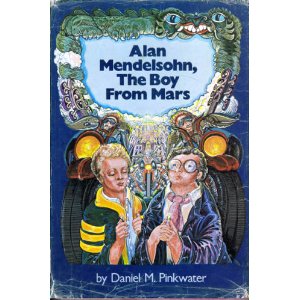
ALAN MENDELSOHN, THE BOY FROM MARS by Daniel Pinkwater


What?!?!?! A review of a kid's book not written by JJ? What is this world coming to?

The time had come for me to re-read Alan Mendelsohn, the Boy From Mars. I first read this book when I was nine years old and as an adult, I tend to go back and read it every two or three years. I've always enjoyed the story and it holds up pretty well, even after all these years.

The story is told by Leonard Neeble, a short, portly kid with glasses whose family has just moved to the neighborhood of West Kangaroo Park. He attends Bat Masterson Junior High School where all the kids seem to be tall, tan and don't wear glasses. Leonard doesn't fit in and struggles with school as a result.

One day a new kid starts school there, Alan Mendelsohn, who is also "uncool". Mendelsohn is from the Bronx and the two become friends.

Leonard starts to see a psychiatrist who recommends he takes some time off from school. Alan starts a riot which results in him being suspended. The pair use their time off from school to go into Hogboro to look for comic books. They encounter Samuel Klugarsh, a purveyor of books on the occult. He convinces the boys to purchase a course in mind control. They take the course home and learn how to control the actions of others. The only thing they seem to be able to get anyone to do, though, is to make them take off their hats and rub their bellies (with an occasional dance).

Bored, they return to Klugarsh and trade the course in for one on Hyperstellar Archeology, which involves the study of lost civilizations like Atlantis and Waka-Waka. The course comes with Yojimbo's Japanese-English Dictionary and seems like complete nonsense. It tells how there are chickens as smart as Einstein and that packaged pudding can be turned into a deadly explosive with the addition of an unnamed substance found in most households. The pair make fun of the course until it mentions them by name, saying one day they will read about the lost civilizations.

They meet up with Klugarsh at the Bermuda Triangle Chili Parlor where a member of a biker gang there having chili exposes himself as noneother than Clarence Yojimbo, a Venusian man and author of the aforementioned Dictionary. He tells them that Klugars hahs everything mixed up and gives them the true key to reaching "lost civilizations", one of which they travel to and save from a trio of Nafsulian pirates.

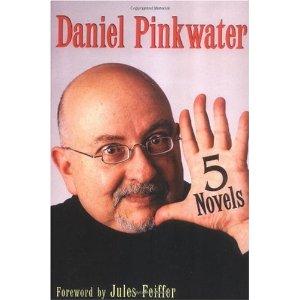
I love this story. It's a lot of fun and very clever. The original, pictured on the left, isn't easy to find. But Pinkwater relased a book of five of his novels, including Alan Mendelsohn, which is pictured on the right. I did not read all of the stories in there. I find Pinkwater to be uneven in his writings. The Last Guru, which is in Five Novels, also is good. I couldn't finish Slaves of Spiegel and didn't feel like reading the other two stories in Five Novels. My other favorite Pinkwater title is Lizard Music. Not quite as enjoyable as Alan Mendelsohn but a good one, nonetheless.

Some of you might recognize Pinkwater as he sometimes appears on National Public Radio as a commentator. He still writes children's novels. If you're looking for something off the beaten path for youngsters, check him out.

--Jon

Thursday, March 24, 2011

CATCHING FIRE AND MOCKINGJAY by Suzanne Collins


So now I have read Catching Fire and Mockingjay, the last two books of the Hunger Games Trilogy by Suzanne Collins.

After the first book, I wondered where the moral outrage against the leaders in the Capitol was. Well, it shows up in the second book. Unrest in a few of the districts is heard as rumor. Security is tightened in District 12, Katniss’s home. And a new hunger game is begun. This time the players are chosen from among the previous Hunger Game winners. So Katniss is back in the thick of things again, forming alliances with the other players and vowing to keep her friends from being killed.

And then fighting against the Capitol takes over in all the districts and Katniss reluctantly becomes the symbol of rebellion, the mockingjay, a bird that’s a cross between a mocking bird and a jay which can repeat the songs of humans.

Is Katniss in favor of the rebellion? Does she see it as a way to punish the Capitol leaders? Is she defending her friends and family? Is she guilty of the deaths of innocent people? Would she fight for survival if it meant killing her friends? Or is she being manipulated by the leaders of the rebellion who would repeat the crimes of the leaders of the Capitol?

In the end, all of what she was initially fighting for is lost, but for one steadfast relationship that leads her to a peaceful new life. Phew. At last.

SS

Saturday, March 19, 2011

AGAINST MEDICAL ADVICE by James Patterson and Hal Friedman


When I found Against Medical Advice by James Patterson and Hal Friedman while browsing the nonfiction collection, I decided to read it simply because a certain friend of mine does not appreciate James Patterson, a very popular fiction writer. Never having read a Patterson book, I thought it would be fun to try one. This story, which he co-wrote with Hal Friedman, is his first nonfiction book.

Cory Friedman woke up one morning when he was almost five years old with an uncontrollable urge to shake his head. His irrepressible movements and tics and unmanageable utterances began to take over his life. This book is the story of thirteen years of his life, living with Tourette’s Syndrome, a neurological disorder characterized by repetitive, involuntary movements and vocalizations called tics. His parents take him to many specialists and try different treatments. At some points Cory is taking so much medication, it is hard to distinguish whether his symptoms are caused by Tourette’s or by the side effects of the medicine.

The story is told in Cory’s voice. It is easy to read and very interesting. I was hoping for more information about the disorder, but this was just a surface tale of his day-to-day life of living with a very misunderstood illness. People were rude to him; he didn’t fit in at school; he felt like a failure most of the time. Throughout his life, his parents were supportive of him and took extreme measures to help him. At one point, Cory discovered that alcohol was the only thing that gave him relief from his tortuous and exhausting tics. His mom and dad intervened and sent him to a wilderness camp so he would escape all temptation and be forced to struggle through withdrawal.

Patterson’s co-author, Hal Friedman, is Cory’s father. He had to live through his son’s nightmarish teenage years, and has earned my respect.

The book ends on a good and surprising note, which is hard to believe, but full of hope. (Whether I’m going to read more by James Patterson – we’ll see.)

JJ

Thursday, March 17, 2011

BATTLE HYMN OF THE TIGER MOTHER by Amy Chua

 
I read this book only after seeing Ms. Chua being interviewed on two different occasions on NBC’s Today. The first interview was with Matt Lauer who asked questions about her daughters’ musical accomplishments and why she wrote the book. Not an interview that made me stop making the bed to listen.  Meredith Vieira on the other hand, demanded explanation as to why she called her own daughter garbage and quoted demeaning arguments between Amy and Lulu from the book. As a parent of teenagers, this is what got me interested. My sons have never given me back talk, we have great relationships, but I’m always wary of this possibility looming in the background.
Ms. Chua point-blankly describes Chinese parenting versus Western parenting in very basic principles. Chinese parents treat children as resilient beings; they are innately tough and will rebound stronger as a result of struggle. Western parents treat their children as fragile beings who must be protected from emotional damage.  Western parents tend to encourage children to try out new things and cheer them on. “You never know if you’ll like it unless you try it.” Chinese parents assign their children to do something, set the bar high, and expect outstanding achievement while the parent cracks the whip to make it happen. Second best is unacceptable. Western parents are proud of their children while Chinese parents credit themselves for their child’s accomplishments. A Western parent would never do that! Yea,right!
Although a lot of the story is written to sell the book, with long dialogues of nasty arguments and cameo appearances of the girls’ father that leaves the reader wondering why he allows this to go on, the summation is that the task of parenting is daunting and there is no one perfect way. Learning from Amy’s mistakes – which she admits - and strengths can give a parent a new direction when working with their own child.
Amy let Lulu have control of her own violin playing and allowed her to try tennis.  Now my son practices his piano more and will continue to take lessons through the sport season (from a teacher less than a mile away, not a weekly 5 hour travel commitment), where in the past we took “time off” from piano to play.
Compromise.

--Kristin

Tuesday, March 15, 2011

THAT OLD CAPE MAGIC by Richard Russo


After reading Straight Man, I was looking forward to reading more of Richard Russo. I had heard good things about That Old Cape Magic and decided to read it. The two books share some similarities. The main character is a middle-aged male professor sort of going through a mid-life crisis. Whereas in Straight Man, the book is witty and entertaining, I thought TOCM was sort of sad and desperate. The writing was still terrific and I kept wanting to read it for that reason, but for that reason alone. I just don't know that a novel about someone else's personal problems is all that enticing.

Unfortunately, I don't there is much of a plot outside of the crisis. It felt like more of a character sketch. The thing is, and perhaps this is some of the appeal of the book to others, Russo's characters are very normal and mundane. Boring, even. The lack of anything special or positive about them made me not care about how the book ended or what happened to any of them.

I'm also not sure if I care whether or not I read more Russo. This wasn't quite terrible but it certainly wasn't Straight Man. Given the number of other books out there, I don't know if I feel like gambling on a third book by him.

Friday, March 11, 2011

KNOCKEMSTIFF by Donald Ray Pollock


This was a weird, crazy, depressing book. I'm going to steal a review from the author's website:

"Spanning a period from the midsixties to the late nineties, the stories in Knockemstiff feature a cast of recurring characters who are woebegone, baffled, and depraved—but irresistibly, undeniably real. Rendered in the American vernacular with vivid imagery and a wry, dark sense of humor, these thwarted and sometimes violent lives jump off the page at the reader with inexorable force. . . . Donald Ray Pollock presents his characters and the sordid goings-on with a stern intelligence and a bracing absence of value judgments. . . . Knockemstiff is a genuine entry into the literature of place."

Knockemstiff, Ohio is a real place and the town from where Pollock hails. To me, the key words in the above review are "depraved", "sometimes violent" and "bracing absence of value judgments". Oh, and "sordid goings-on". Humor? Intelligence? If they were there, they were trampled by the depravity. I found this to be a rather disturbing book and although I read something somewhere where Pollock says that the stories are not based on real people, I'm not sure what is more disturbing - that the book might be based on real people or that Pollock thought them up.


Lest you think I'm kidding, that maybe I think of depravity as, oh, returning a library book late, here are some topic matters in the book: rape, incest, murder, drug and alcohol abuse.

While I did find the book to be weird, crazy and depressing (and sordid and disturbing), I thought the writing was pretty good. I just don't know that I thought it was good enough to say, hey, check it out but be aware of the content. There is plenty of good writing out there that isn't disturbing (like Susanna Clarke's Jonathan Strange and Mr. Norrell which STILL sits on the Staff Picks shelf waiting for you, yes YOU, to pick it up and read it).

--Jon

Tuesday, March 8, 2011

THE IMMORTAL LIFE OF HENRIETTA LACKS by Rebecca Skloot


Okay, I need to admit that I was never one to excel at science classes. I made it to and through high school biology and then set my sights on more nonscientific pursuits in life (basically anything that did not involve cutting into frogs or stabbing pins through insects). So, I did not know much about cell growth or genetic science before reading The Immortal Life of Henrietta Lacks. Scientific smarts is not needed to enjoy this book. You can read it like a novel and fly through it, or you can read it like a textbook and learn more than you ever could from a class.

In 1951, George Gey cultured the first immortal human cell line using cells from Henrietta Lacks's cervix. Henrietta died in 1951 from cervical cancer. The HeLa cells (named for the first two letters of Henrietta’s first and last names) were a boon to medical and scientific research, soon becoming in demand around the world. With the HeLa cells, a polio vaccine was developed. They were also the first human cells ever cloned.

Rebecca Skloot learned about HeLa cells when she was young and eventually set out to uncover the history of the woman they came from. Years of research entwined Rebecca’s life with the embittered Lacks’ family, who received no financial compensation for the cells. In fact, it was not until 1973 that Henrietta’s family learned the cells were still alive. They later found out the cells had been commercialized, yet they received nothing.
  
The author’s Web site http://rebeccaskloot.com/the-immortal-life/ says: “The Immortal Life of Henrietta Lacks tells a riveting story of the collision between ethics, race, and medicine; of scientific discovery and faith healing; and of a daughter consumed with questions about the mother she never knew. It’s a story inextricably connected to the dark history of experimentation on African Americans, the birth of bioethics, and the legal battles over whether we control the stuff we’re made of.”

Another great book!

JJ

Saturday, March 5, 2011

RUNNING THE BOOKS by Avi Steinberg


Wow, wow, wow! Wow! Wow, wow, wow!

Did I mention wow? I loved this book. And yes, as a librarian, you'd expect me to be biased because this is about a prison librarian. Doesn't matter. This is just a great book.

The author, Avi Steinberg, is an interesting cross between successful and ne'er-do-well. He grew up in a moderately well-to-do family and graduated from Harvard. He's Jewish and was an absolute zealot in his childhood, studying scripture at all times. He lost his way in college, got involved with drugs a bit, wrote his senior thesis on Bugs Bunny, and found himself writing obituaries in his twenties, just sort of aimlessly going through life.

He attends a Jewish gathering where he is somewhat berated by his former mentor. Steinberg had recently seen an ad for a position as a prison librarian at a Boston prison. Motivated by his encounter with his mentor, he decides to apply and hopefully help those less fortunate than himself.

Steinberg gets the job and spends the next two and a half years in a sort of intriguing limbo. As a prison librarian, he is supposed to help the prisoners and provide them with books and resources to help them better themselves. He is, however, an employee and as such is supposed to keep himself detached from the inmates. The fine line he walks and the times he falls into one side or the other make up the majority of the book.

Steinberg's struggles is part of what makes the book so great. He is honest - with himself and with his readers. You can tell that there were certain inmates for whom he cared and wanted to see do well. But he knows also that these people are in prison for a reason and that most of them, if they get out, will return to a life of crime. Steinberg is even mugged at knifepoint by a former inmate at one point. The mugger recognizes Steinberg and comments that he still has books from the library. Their past together does not stop the mugger from taking what he wants.

This isn't the only encounter Steinberg has with former prisoners on "the outside". He runs into another inmate at a donut shop and sits and chats with him for a little bit. Suddenly, a former female prisoner comes out from the bathroom and the realization sets in that the male ex-con is now the woman's pimp.

It would take me a zillion edits for me to adequately express how I feel about this book. I like that Steinberg is not judgmental. There are some easy opportunities for him to generalize on race, economic and social status, etc. He does a good job at avoiding that and really is able to look at each individual as a unique person. He sees the good and bad and shares both sides with the reader.

Beyond that, the book is informative. You get an understanding of prisons from a very different standpoint. A prison librarian is in a special position. He or she does not have the authority of a guard. The librarian is usually a civilian employee. Because the librarian is often helping the prisoners, the guards aren't always on the side of the librarian. This can make for some awkward situations because, likewise, the librarian is not a prisoner and so the prisoners, too, are not always on the side of the librarian. It seemed like a tough job and ultimately, the stress of the job causes Steinberg to quit.

For me, one of the characteristics of an excellent work of non-fiction is the ability to make me want to learn more about something after I've read the book. Steinberg motivated me to want to learn more about a topic. There is a section where he delves into prisons and their history. That has prompted me to get a couple of books on prison architecture, which Steinberg gets into during the history section. It's not something I ever really thought much about but Steinberg made me want to learn more.

The only bad thing I can say about this book is the ending isn't quite satisfying. It's neither good nor bad. I guess it felt a little unfinished to me. Outside of that, this is an absolutely phenomenal book and one I will probably read again down the road. It has passed Unbroken for my top book of 2011.

Oh, I almost forgot. Love the dustjacket on this book, too. A portrait of Steinberg done with library date due stamps. Too cool.

--Jon

Tuesday, March 1, 2011

THE HUNGER GAMES by Suzanne Collins

Katniss Everdeen and her family live in a futuristic country where districts are fenced off from wilderness and residents toil to provide the Capitol with all the food and energy that the leaders need. Conditions are spare and most residents go cold and hungry.

The Hunger Games are a diversion for the amusement of the Capitol. Two teenagers are chosen by lottery from each of the 12 districts. These 24 must fight to the death. When Katniss’s younger sister is drawn to represent her district, Katniss volunteers to take her place.

The Hunger Games is a fast-paced read which took me quickly through the set up and suspense of the games. I was expecting an outrage against the Capitol for forcing these teens into combat against each other. Instead, as is reasonable for facing death, Katniss deals with survival, humanity, and love at a personal level. I guess I’ll need to read the rest of the trilogy, Catching Fire and Mockingjay, to find out if enough rebellion exists to bring down the Capitol.

SS