Sunday, July 24, 2011

CASTLE by Robert Lennon


Castle is a book that I couldn't really decide if I liked or not. It was spooky. A guy buys a house with a huge amount of land (over six hundred acres of woods) in the town where he grew up in upstate New York. The guy isn't all that friendly and not many people in town recognize him. When he interacts with folks, he seems to find a way to alienate them.

Despite growing up in the town, he doesn't have family there and the reader is left to wonder why on earth he came back. As he fixes his house up, he finds that he can see a giant rock outcropping out on his property. When he checks the property map, he is surprised to discover that where the outcropping is, smack in the middle of his land, is a plot of land owned by someone else whose name has been removed from the records. There are no points of entry to this area. All is confuseded.

Upon investigating the outcropping, he discovers a castle. To talk about it anymore would ruin the story. The outcome involves the discovery of the narrator's past which is a wacky one indeed. As a matter of fact, it is so out there, it sort of ruins the story for me.

I liked the writing, though. I wanted to press on throughout the story. Everything is detailed well but still the story is mysterious. Who is this guy? Why did he come back? What's the castle all about? Why does this guy alienate everybody? You feel like you're getting a lot of information but you can't seem to piece it together. When the pieces are put together, you're left feeling like this was some other puzzle. It was just really unsatisfying for me.

Ultimately, I think I didn't like this book. The writing style couldn't overcome a lousy denouement.

--Jon

Friday, July 22, 2011

I AM THE MARKET by Luca Rastello


Subtitled "How to Smuggle Cocaine by the Ton in Five Easy Lessons", I was hoping I might pick up some sort of business lesson, even if I'm not a drug dealer myself. At the very least I hoped for an interesting story. My hopes were dashed all around.

The book seems to be one extensive interview of a former semi-successful coke smuggler by an Italian journalist. The coke smuggler himself would tell you he was more than successful but being as he's saying that from prison, I'll disagree.

The dealer is full of himself, the interview seemed as if it was lightly edited, and outside of some interesting tidbits, but not necessarily facts, I didn't enjoy it that much. Despite the title, each of the five chapters isn't really a lesson in and of itself. It's just a bunch of rambling about the drug trade from the dealer. The author of the book, an Italian journalist, interviewed the dealer and then appears to not have edited the transcription in the least. Or maybe he did, which would be even more sad.

The book is a reliving of the guy's glory days and he talks about some of the ways he smuggled cocaine which are no longer valid because they've been shut down by law enforcement.

About the only thing good about this book are some of the interesting unsubstantiated claims the guy makes like the "fact" that the drug trade is keeping Florida's banks afloat or that law enforcement officials often buy drug sniffing dogs from the drug cartels themselves. If true, well, yes, that is quite interesting. But how are you going to substantiate the claim?

Given the lack of anything remotely concrete, the amount of braggadocio, and the fact that five chapters does not equate five lessons if there is no structure, I cannot really recommend this book, even if it is short.

--Jon

Wednesday, July 20, 2011

ASSASSINATION VACATION by Sarah Vowell


I can't speak for my co-workers but I just got out of the habit of doing book review here. I'm going to try and catch up with Sarah Vowell's Assassination Vacation.

I kept coming across reviews of Sarah Vowell's new book, Unfamiliar Fishes, and it looked mighty good. It's a history of Hawaii, which, despite my operating hawaii-baseball.com, isn't a topic in and of itself that I would want to read a book about.

Then again, I wouldn't really want to read a book about presidential assassinations which this book is about. Nonetheless, I did.

Sarah Vowell is weird. I like that about her. Her writing reminded me a lot of another weird woman writer, Mary Roach. You have to be weird to be researching the killings of presidents. And not only researching, but visiting all the pertinent places. Not just where the killings took place, but the homes of the presidents and the killers. And museums that have fragments of body parts from those involved.

What sets apart the book from your typical delving into dead presidents is that Vowell has fun. And she definitely seems like someone who isn't going to enjoy something on her own so she drags along/tricks friends and relatives to accompany her to all the places. Her trips with her nephew are especially entertaining.

I like her writing, too. It is very conversational. I don't like her overuse of the word "lousy" to mean abundant, as in "This place is lousy with tourists". She is also very zealous in her politics which could kill a lot of people's interest in the book. But she's honest and doesn't care who knows.

The book itself is broken into four chapters. The longest and first covers Lincoln's assassination. That is followed by Garfield and McKinley and then the final chapter wraps things up with a semi-focus on angel of presidential death, Robert Todd Lincoln. His father was killed, he saw Garfield be shot and he supposedly was on the scene where McKinley was shot soon after the attack.

This was a fun book and I expect I'll read more of Vowell somewhere down the road.

--Jon

Friday, April 29, 2011

MOONWALKING WITH EINSTEIN by Joshua Foer


When I first saw that Joshua Foer had written a book, my initial reaction was, "Why not ride the coattails of big brother?" I've loved Jonathan Safron Foer's two novels and thought his non-fiction work on vegetarianism was good, too.

But it turned out I was just ignorant of what Joshua Foer has accomplished as a journalist. He is a mighty fine writer, in his own way just as talented as Jonathan. He also seems somehow less serious yet more driven. Maybe I'm reading into things too much. Or basing things too much, in part, on Colbert Report interviews.

The Colbert ReportMon - Thurs 11:30pm / 10:30c
Joshua Foer
www.colbertnation.com
Colbert Report Full EpisodesPolitical Humor & Satire BlogVideo Archive

The Colbert ReportMon - Thurs 11:30pm / 10:30c
Jonathan Safran Foer
www.colbertnation.com
Colbert Report Full EpisodesPolitical Humor & Satire BlogVideo Archive

The interview with Colbert explains Moonwalking with Einstein pretty well. Foer (from here on out, any mention of Foer by me is Joshua) is investigating memory competitors and finds that none of them are gifted in any unusual way. That is, their brains aren't any different from yours or mine. What is different is that they have trained themselves using techniques so that their memory is extremely well-developed.

Foer begins training with a memory expert from England and over the course of a year develops his skills enough that he becomes the U.S. Memory Champion. The book largely is about his journey with sidebars into the science of the brain and memory.

To me, there was a big question over whether or not the effort is worth it. The tricks used to improve memory take a lot of work and Foer finds that for all his ability to memorize lists of digits or decks of playing cards, none of his work helps him with things like remembering where he put his keys.

I'll wrap up with two things I particularly found interesting. One was a technique called the memory palace that is the primary device used by competitive memory experts. It was developed way back in ancient Greece. The idea is that you take a place with which you are very familiar, like your home or childhood home. Then, when you have a list of things to memorize, you picture each item in a strange circumstance in a spot of the home and then you tour your home in your memory. For example, say you have a grocery list. The first item is tomatoes. You picture a gorilla on your mailbox juggling tomatoes. The next item is ground meat. Maybe you picture a car made out of ground meat parked in your driveway. The example Foer gave that still sticks with me is cottage cheese. His example is picturing Claudia Schiffer soaking in a tub of cottage cheese. In my example here, Claudia and the vat are in the doorway of my home. Keep going through your home and your list is complete.

It seems counterintuitive at first that such a technique should work. Because now you are memorizing not only cottage cheese, but a hot tub, Claudia Schiffer and the door to your home. But the outrageous image coupled with something familiar works as a trigger point and helps you remember.

The other noteworthy thing to me is that Foer works with Dr. Anders Ericsson of Florida State. Dr. Ericsson is an expert on experts. He has been in the news recently as media attention has been given to Dan McLaughlin. McLaughlin has been putting a theory of Ericsson's, that it takes 10,000 hours of deliberate practice to become an expert, to test. McLaughlin had never played golf and has been working to put in the hours to become a professional golfer. I find it pretty fascinating and have added McLaughlin's blog to my RSS reader. Ericsson's theory also received a lot of attention in Malcolm Gladwell's book Outliers.

I really loved Foer's book. I definitely recommend it to everyone.

--Jon

Saturday, April 23, 2011

MOBY DUCK by Donovan Hahn


I have to hand it to Donovan Hahn. If you're going to take the title of your book from the wandering, tangential, verbose similarly named book of Herman Melville's, you ought to live up to it. He does. Not in the sense that Hahn's work is a classic. In the sense that it is sprawling, rambling, and filled with words that you wouldn't ever use yourself.

Moby Duck is about Hahn's search to understand more about a shipment of bathtub toys that were spilled by a cargo ship during a storm in the early 1990's. Years later, some of those toys began washing up in all sorts of places around the world and it piqued Hahn's interest. This book talks about every aspect of the incident that you could possibly think of.

You learn about cargo ships, ocean currents, the Arctic, toymaking in China, beachcombing, trash, boots, flotation devices, seasickness, being a father, and so much more. No stone is left unturned, no thought left unwritten. If I thought T.C. Boyle was bad about using big words, well, I think even he would need a dictionary to get through Moby Duck.

And it's not just big words. Hahn uses big sentences and I don't understand why. I tried to think why someone would do such a thing. Is it to show off? Who is your target audience when you write that way and why doesn't your editor do something about it? I don't know. It bugged me. No, you don't have to dumb down your book, but I think some people might give up or get frustrated when they're coming across a word every other page that they don't recognize.

For all my complaining, though, I did enjoy the book. It was different and it was thorough. The thoroughness slowed things down at times as Hahn went off to pursue some line of thought I couldn't care less about but, like Melville, he eventually came back to the crux of the story.

It's interesting enough that I would recommend it to folks. It'll probably take some time to read but in the end, I think you'll find it worthwhile.

--Jon

Friday, April 22, 2011

When the Killing's Done by T.C. Boyle (trailer)

The publisher of T.C. Boyle's When the Killing's Done, Bloomsbury, got in touch with me after I posted my book review of the book on another website where I write about what I read. They asked that I consider adding the trailer of the book to my review. The concept of trailers for books fascinates me. I included the one I had seen for Super Sad True Love Story in my review of that book and commented on how, while entertaining, it had absolutely nothing to do with the book.

I found this trailer to be pretty good. I think it captures the tone of the book well. The actors they use for the characters of Alma Takesue and Dave LaJoy resemble very much how I pictured them. Not exactly but close enough. The trailer focuses on one particular scene of the book and has some content that is not suitable for children.


Your thoughts? Are book trailers goofy? A good way to capture people's interest who might not be into reading? Something else?

Monday, April 11, 2011

THE PARTICULAR SADNESS OF LEMON CAKE by Aimee Bender

It's not often that I write an author. As a matter of fact, it has only happened once. I sent Aimee Bender an e-mail after reading her first novel, An Invisible Sign of My Own. That book was really different, about a young woman with an odd relationship with numbers. I could sort of relate as I have my own thing with numbers, nothing similar to the main character in that book, and I liked that someone was able to capture the unusual workings of such a person's mind. So I snapped off a quick thank you and received a nice reply back.

I wont be writing her again after reading The Particular Sadness of Lemon Cake. Not because the book wasn't good. It was fantastic. Just because, that's why.

Once again, Bender's book focuses on a young girl. The book jumps forward in time and by the end, the girl, Rose, is in her twenties. She is nine years old at the beginning. Why? Because that is when she discovers that she can taste the feelings of people in the food they make. Her mother makes a lemon cake and when Rose tries it, she finds that she can taste the sadness of her mother in it.

Growing up, she tries to avoid homemade food because of her unwillingness to taste emotion. She relies on processed foods as much as possible and somehow manages to hide her "gift" from everyone but her brother's best friend.

Part of the reason she is able to hide her ability is that her family is a tad dysfunctional. Her brother is aloof, and as he gets older, he vanishes for periods of time. Rose's father is a lawyer who provides for his family but seems to do little else. The mother we know is sad. She also seems to lack focus in her life until she starts working at a carpentry co-op.

As the book progresses through Rose's narration, we naturally find out more about all the characters and the secrets that some of them possess. A lot of what is exposed comes from her being able to tell things from food. Some of it is told to her. Some of it seems to come from nowhere. This last bit can be a bit annoying at times if you stop to think about why on earth she would know such things. I wasn't bothered by it much. The ending has good and bad twists. Unexpected to say the least. In terms of a plot, I don't know that there's much of one. Just the life of an unusual girl and her messed up family.

I do know that despite being in the middle of several other books, I put them all on hold to plow through this one. I loved it. It's my favorite work of fiction that I have read this year. It's not for everybody nor is her other book. I would even hazard a guess that if we polled everyone who has or does read it, more will not like it than those who will and I can understand that. Sure enough, on Amazon right now, there are 115 4 or 5-star reviews compared to 112 reviews of three stars or less. If you're not sure whether to take a gamble on it, keep in mind that Bender's writing is very crisp and concise. The book moves along. I'd say take a shot. If it grabs you early on, I expect you'll finish it and like it. You won't read anything like it.

--Jon

Oh, just as a P.S. aside, one of the things that struck me about Bender is that she is/was part of a writing group in L.A. Two of the other members of that writing group are/were Glen David Gold, author of one of my all-time favorites Carter Beats the Devil, and Gold's wife, Alice Sebold, author of several books including The Lovely Bones. That's some fine company to be keeping.

Friday, April 8, 2011

WHEN THE KILLING'S DONE by T.C. Boyle


T.C. Boyle is one of my favorite writers. He has an amazing way with words, being able to really capture the essence of a point in time, often with multiple senses, without bogging down the story or making it feel overbearing. He also does a great job with character development and dialogue. His works, though fiction, seem real. His novel about Frank Lloyd Wright, The Women, is my favorite book of his I have read.

When the Killing's Done is typical Boyle. The story takes place around the Channel Islands off of California. Alma Takesue is a National Park Service biologist who is out to eradicate invasive wildlife from the islands. Dave LaJoy is an owner of a chain of successful electronic retail stores who has issues with Alma killing off animals of any kind. He heads an organization called For the Protection of Animals that tries a variety of techniques to stop Alma from going through with her plans.

Although Alma and Dave are the main characters, there are also a number of secondary characters, the most notable being Dave's girlfriend Anise. The reader is taken into the past and learns about Alma's mother and grandmother as well as Anise's mother. These little forays help in the understanding of the characters and their motivations. The narration of the story also jumps around from character to character presenting the viewpoints of each character and making it unclear as to who is the good guy and who is not.

While Boyle paints pretty literary pictures, there are some negatives with this book. First, it is extremely stressful. The antagonism between Alma and Dave is obvious and incessant. They think of each other so much, they should be lovers instead of enemies. Both are committed to saving the environment, each in their own way. The way Boyle depicts their reasoning, it makes it difficult to determine who is right on an issue and who is wrong, or even if there is a right or wrong. The ending has a twist that even throws another entire viewpoint into the discussion; does either side even matter?

Another potential negative for some people is Boyle's vocabulary. I always learn new words reading his books and this one seemed better than most. I wasn't running off to look up new words as frequently as I did with other works of his. But it's like they say, why use a big word when a diminutive one will do?

Finally, and maybe it is just me, I really hate reading about smells. I think my sense of smell is my least developed sense and maybe that's why I get irked reading about smells. For better or worse, Boyle writes about smells.

A well-told story with great writing and developed characters outweigh the negatives. Of the Boyle books in our library, I'd probably put it third, behind The Women and Wild Child. The Women is very hefty and not a book that is a casual read. Wild Child is a collection of short stories, a format that Boyle excels at, but one that is different from a novel. So that makes this book a good one to pick up if you're looking for an introduction to Boyle's work.

--Jon

Tuesday, March 29, 2011

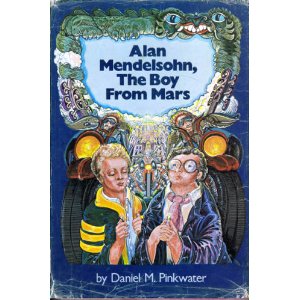
ALAN MENDELSOHN, THE BOY FROM MARS by Daniel Pinkwater


What?!?!?! A review of a kid's book not written by JJ? What is this world coming to?

The time had come for me to re-read Alan Mendelsohn, the Boy From Mars. I first read this book when I was nine years old and as an adult, I tend to go back and read it every two or three years. I've always enjoyed the story and it holds up pretty well, even after all these years.

The story is told by Leonard Neeble, a short, portly kid with glasses whose family has just moved to the neighborhood of West Kangaroo Park. He attends Bat Masterson Junior High School where all the kids seem to be tall, tan and don't wear glasses. Leonard doesn't fit in and struggles with school as a result.

One day a new kid starts school there, Alan Mendelsohn, who is also "uncool". Mendelsohn is from the Bronx and the two become friends.

Leonard starts to see a psychiatrist who recommends he takes some time off from school. Alan starts a riot which results in him being suspended. The pair use their time off from school to go into Hogboro to look for comic books. They encounter Samuel Klugarsh, a purveyor of books on the occult. He convinces the boys to purchase a course in mind control. They take the course home and learn how to control the actions of others. The only thing they seem to be able to get anyone to do, though, is to make them take off their hats and rub their bellies (with an occasional dance).

Bored, they return to Klugarsh and trade the course in for one on Hyperstellar Archeology, which involves the study of lost civilizations like Atlantis and Waka-Waka. The course comes with Yojimbo's Japanese-English Dictionary and seems like complete nonsense. It tells how there are chickens as smart as Einstein and that packaged pudding can be turned into a deadly explosive with the addition of an unnamed substance found in most households. The pair make fun of the course until it mentions them by name, saying one day they will read about the lost civilizations.

They meet up with Klugarsh at the Bermuda Triangle Chili Parlor where a member of a biker gang there having chili exposes himself as noneother than Clarence Yojimbo, a Venusian man and author of the aforementioned Dictionary. He tells them that Klugars hahs everything mixed up and gives them the true key to reaching "lost civilizations", one of which they travel to and save from a trio of Nafsulian pirates.

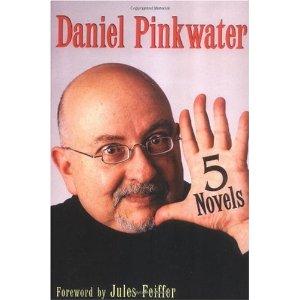
I love this story. It's a lot of fun and very clever. The original, pictured on the left, isn't easy to find. But Pinkwater relased a book of five of his novels, including Alan Mendelsohn, which is pictured on the right. I did not read all of the stories in there. I find Pinkwater to be uneven in his writings. The Last Guru, which is in Five Novels, also is good. I couldn't finish Slaves of Spiegel and didn't feel like reading the other two stories in Five Novels. My other favorite Pinkwater title is Lizard Music. Not quite as enjoyable as Alan Mendelsohn but a good one, nonetheless.

Some of you might recognize Pinkwater as he sometimes appears on National Public Radio as a commentator. He still writes children's novels. If you're looking for something off the beaten path for youngsters, check him out.

--Jon

Thursday, March 24, 2011

CATCHING FIRE AND MOCKINGJAY by Suzanne Collins


So now I have read Catching Fire and Mockingjay, the last two books of the Hunger Games Trilogy by Suzanne Collins.

After the first book, I wondered where the moral outrage against the leaders in the Capitol was. Well, it shows up in the second book. Unrest in a few of the districts is heard as rumor. Security is tightened in District 12, Katniss’s home. And a new hunger game is begun. This time the players are chosen from among the previous Hunger Game winners. So Katniss is back in the thick of things again, forming alliances with the other players and vowing to keep her friends from being killed.

And then fighting against the Capitol takes over in all the districts and Katniss reluctantly becomes the symbol of rebellion, the mockingjay, a bird that’s a cross between a mocking bird and a jay which can repeat the songs of humans.

Is Katniss in favor of the rebellion? Does she see it as a way to punish the Capitol leaders? Is she defending her friends and family? Is she guilty of the deaths of innocent people? Would she fight for survival if it meant killing her friends? Or is she being manipulated by the leaders of the rebellion who would repeat the crimes of the leaders of the Capitol?

In the end, all of what she was initially fighting for is lost, but for one steadfast relationship that leads her to a peaceful new life. Phew. At last.

SS

Saturday, March 19, 2011

AGAINST MEDICAL ADVICE by James Patterson and Hal Friedman


When I found Against Medical Advice by James Patterson and Hal Friedman while browsing the nonfiction collection, I decided to read it simply because a certain friend of mine does not appreciate James Patterson, a very popular fiction writer. Never having read a Patterson book, I thought it would be fun to try one. This story, which he co-wrote with Hal Friedman, is his first nonfiction book.

Cory Friedman woke up one morning when he was almost five years old with an uncontrollable urge to shake his head. His irrepressible movements and tics and unmanageable utterances began to take over his life. This book is the story of thirteen years of his life, living with Tourette’s Syndrome, a neurological disorder characterized by repetitive, involuntary movements and vocalizations called tics. His parents take him to many specialists and try different treatments. At some points Cory is taking so much medication, it is hard to distinguish whether his symptoms are caused by Tourette’s or by the side effects of the medicine.

The story is told in Cory’s voice. It is easy to read and very interesting. I was hoping for more information about the disorder, but this was just a surface tale of his day-to-day life of living with a very misunderstood illness. People were rude to him; he didn’t fit in at school; he felt like a failure most of the time. Throughout his life, his parents were supportive of him and took extreme measures to help him. At one point, Cory discovered that alcohol was the only thing that gave him relief from his tortuous and exhausting tics. His mom and dad intervened and sent him to a wilderness camp so he would escape all temptation and be forced to struggle through withdrawal.

Patterson’s co-author, Hal Friedman, is Cory’s father. He had to live through his son’s nightmarish teenage years, and has earned my respect.

The book ends on a good and surprising note, which is hard to believe, but full of hope. (Whether I’m going to read more by James Patterson – we’ll see.)

JJ

Thursday, March 17, 2011

BATTLE HYMN OF THE TIGER MOTHER by Amy Chua

 
I read this book only after seeing Ms. Chua being interviewed on two different occasions on NBC’s Today. The first interview was with Matt Lauer who asked questions about her daughters’ musical accomplishments and why she wrote the book. Not an interview that made me stop making the bed to listen.  Meredith Vieira on the other hand, demanded explanation as to why she called her own daughter garbage and quoted demeaning arguments between Amy and Lulu from the book. As a parent of teenagers, this is what got me interested. My sons have never given me back talk, we have great relationships, but I’m always wary of this possibility looming in the background.
Ms. Chua point-blankly describes Chinese parenting versus Western parenting in very basic principles. Chinese parents treat children as resilient beings; they are innately tough and will rebound stronger as a result of struggle. Western parents treat their children as fragile beings who must be protected from emotional damage.  Western parents tend to encourage children to try out new things and cheer them on. “You never know if you’ll like it unless you try it.” Chinese parents assign their children to do something, set the bar high, and expect outstanding achievement while the parent cracks the whip to make it happen. Second best is unacceptable. Western parents are proud of their children while Chinese parents credit themselves for their child’s accomplishments. A Western parent would never do that! Yea,right!
Although a lot of the story is written to sell the book, with long dialogues of nasty arguments and cameo appearances of the girls’ father that leaves the reader wondering why he allows this to go on, the summation is that the task of parenting is daunting and there is no one perfect way. Learning from Amy’s mistakes – which she admits - and strengths can give a parent a new direction when working with their own child.
Amy let Lulu have control of her own violin playing and allowed her to try tennis.  Now my son practices his piano more and will continue to take lessons through the sport season (from a teacher less than a mile away, not a weekly 5 hour travel commitment), where in the past we took “time off” from piano to play.
Compromise.

--Kristin

Tuesday, March 15, 2011

THAT OLD CAPE MAGIC by Richard Russo


After reading Straight Man, I was looking forward to reading more of Richard Russo. I had heard good things about That Old Cape Magic and decided to read it. The two books share some similarities. The main character is a middle-aged male professor sort of going through a mid-life crisis. Whereas in Straight Man, the book is witty and entertaining, I thought TOCM was sort of sad and desperate. The writing was still terrific and I kept wanting to read it for that reason, but for that reason alone. I just don't know that a novel about someone else's personal problems is all that enticing.

Unfortunately, I don't there is much of a plot outside of the crisis. It felt like more of a character sketch. The thing is, and perhaps this is some of the appeal of the book to others, Russo's characters are very normal and mundane. Boring, even. The lack of anything special or positive about them made me not care about how the book ended or what happened to any of them.

I'm also not sure if I care whether or not I read more Russo. This wasn't quite terrible but it certainly wasn't Straight Man. Given the number of other books out there, I don't know if I feel like gambling on a third book by him.

Friday, March 11, 2011

KNOCKEMSTIFF by Donald Ray Pollock


This was a weird, crazy, depressing book. I'm going to steal a review from the author's website:

"Spanning a period from the midsixties to the late nineties, the stories in Knockemstiff feature a cast of recurring characters who are woebegone, baffled, and depraved—but irresistibly, undeniably real. Rendered in the American vernacular with vivid imagery and a wry, dark sense of humor, these thwarted and sometimes violent lives jump off the page at the reader with inexorable force. . . . Donald Ray Pollock presents his characters and the sordid goings-on with a stern intelligence and a bracing absence of value judgments. . . . Knockemstiff is a genuine entry into the literature of place."

Knockemstiff, Ohio is a real place and the town from where Pollock hails. To me, the key words in the above review are "depraved", "sometimes violent" and "bracing absence of value judgments". Oh, and "sordid goings-on". Humor? Intelligence? If they were there, they were trampled by the depravity. I found this to be a rather disturbing book and although I read something somewhere where Pollock says that the stories are not based on real people, I'm not sure what is more disturbing - that the book might be based on real people or that Pollock thought them up.


Lest you think I'm kidding, that maybe I think of depravity as, oh, returning a library book late, here are some topic matters in the book: rape, incest, murder, drug and alcohol abuse.

While I did find the book to be weird, crazy and depressing (and sordid and disturbing), I thought the writing was pretty good. I just don't know that I thought it was good enough to say, hey, check it out but be aware of the content. There is plenty of good writing out there that isn't disturbing (like Susanna Clarke's Jonathan Strange and Mr. Norrell which STILL sits on the Staff Picks shelf waiting for you, yes YOU, to pick it up and read it).

--Jon

Tuesday, March 8, 2011

THE IMMORTAL LIFE OF HENRIETTA LACKS by Rebecca Skloot


Okay, I need to admit that I was never one to excel at science classes. I made it to and through high school biology and then set my sights on more nonscientific pursuits in life (basically anything that did not involve cutting into frogs or stabbing pins through insects). So, I did not know much about cell growth or genetic science before reading The Immortal Life of Henrietta Lacks. Scientific smarts is not needed to enjoy this book. You can read it like a novel and fly through it, or you can read it like a textbook and learn more than you ever could from a class.

In 1951, George Gey cultured the first immortal human cell line using cells from Henrietta Lacks's cervix. Henrietta died in 1951 from cervical cancer. The HeLa cells (named for the first two letters of Henrietta’s first and last names) were a boon to medical and scientific research, soon becoming in demand around the world. With the HeLa cells, a polio vaccine was developed. They were also the first human cells ever cloned.

Rebecca Skloot learned about HeLa cells when she was young and eventually set out to uncover the history of the woman they came from. Years of research entwined Rebecca’s life with the embittered Lacks’ family, who received no financial compensation for the cells. In fact, it was not until 1973 that Henrietta’s family learned the cells were still alive. They later found out the cells had been commercialized, yet they received nothing.
  
The author’s Web site http://rebeccaskloot.com/the-immortal-life/ says: “The Immortal Life of Henrietta Lacks tells a riveting story of the collision between ethics, race, and medicine; of scientific discovery and faith healing; and of a daughter consumed with questions about the mother she never knew. It’s a story inextricably connected to the dark history of experimentation on African Americans, the birth of bioethics, and the legal battles over whether we control the stuff we’re made of.”

Another great book!

JJ

Saturday, March 5, 2011

RUNNING THE BOOKS by Avi Steinberg


Wow, wow, wow! Wow! Wow, wow, wow!

Did I mention wow? I loved this book. And yes, as a librarian, you'd expect me to be biased because this is about a prison librarian. Doesn't matter. This is just a great book.

The author, Avi Steinberg, is an interesting cross between successful and ne'er-do-well. He grew up in a moderately well-to-do family and graduated from Harvard. He's Jewish and was an absolute zealot in his childhood, studying scripture at all times. He lost his way in college, got involved with drugs a bit, wrote his senior thesis on Bugs Bunny, and found himself writing obituaries in his twenties, just sort of aimlessly going through life.

He attends a Jewish gathering where he is somewhat berated by his former mentor. Steinberg had recently seen an ad for a position as a prison librarian at a Boston prison. Motivated by his encounter with his mentor, he decides to apply and hopefully help those less fortunate than himself.

Steinberg gets the job and spends the next two and a half years in a sort of intriguing limbo. As a prison librarian, he is supposed to help the prisoners and provide them with books and resources to help them better themselves. He is, however, an employee and as such is supposed to keep himself detached from the inmates. The fine line he walks and the times he falls into one side or the other make up the majority of the book.

Steinberg's struggles is part of what makes the book so great. He is honest - with himself and with his readers. You can tell that there were certain inmates for whom he cared and wanted to see do well. But he knows also that these people are in prison for a reason and that most of them, if they get out, will return to a life of crime. Steinberg is even mugged at knifepoint by a former inmate at one point. The mugger recognizes Steinberg and comments that he still has books from the library. Their past together does not stop the mugger from taking what he wants.

This isn't the only encounter Steinberg has with former prisoners on "the outside". He runs into another inmate at a donut shop and sits and chats with him for a little bit. Suddenly, a former female prisoner comes out from the bathroom and the realization sets in that the male ex-con is now the woman's pimp.

It would take me a zillion edits for me to adequately express how I feel about this book. I like that Steinberg is not judgmental. There are some easy opportunities for him to generalize on race, economic and social status, etc. He does a good job at avoiding that and really is able to look at each individual as a unique person. He sees the good and bad and shares both sides with the reader.

Beyond that, the book is informative. You get an understanding of prisons from a very different standpoint. A prison librarian is in a special position. He or she does not have the authority of a guard. The librarian is usually a civilian employee. Because the librarian is often helping the prisoners, the guards aren't always on the side of the librarian. This can make for some awkward situations because, likewise, the librarian is not a prisoner and so the prisoners, too, are not always on the side of the librarian. It seemed like a tough job and ultimately, the stress of the job causes Steinberg to quit.

For me, one of the characteristics of an excellent work of non-fiction is the ability to make me want to learn more about something after I've read the book. Steinberg motivated me to want to learn more about a topic. There is a section where he delves into prisons and their history. That has prompted me to get a couple of books on prison architecture, which Steinberg gets into during the history section. It's not something I ever really thought much about but Steinberg made me want to learn more.

The only bad thing I can say about this book is the ending isn't quite satisfying. It's neither good nor bad. I guess it felt a little unfinished to me. Outside of that, this is an absolutely phenomenal book and one I will probably read again down the road. It has passed Unbroken for my top book of 2011.

Oh, I almost forgot. Love the dustjacket on this book, too. A portrait of Steinberg done with library date due stamps. Too cool.

--Jon

Tuesday, March 1, 2011

THE HUNGER GAMES by Suzanne Collins

Katniss Everdeen and her family live in a futuristic country where districts are fenced off from wilderness and residents toil to provide the Capitol with all the food and energy that the leaders need. Conditions are spare and most residents go cold and hungry.

The Hunger Games are a diversion for the amusement of the Capitol. Two teenagers are chosen by lottery from each of the 12 districts. These 24 must fight to the death. When Katniss’s younger sister is drawn to represent her district, Katniss volunteers to take her place.

The Hunger Games is a fast-paced read which took me quickly through the set up and suspense of the games. I was expecting an outrage against the Capitol for forcing these teens into combat against each other. Instead, as is reasonable for facing death, Katniss deals with survival, humanity, and love at a personal level. I guess I’ll need to read the rest of the trilogy, Catching Fire and Mockingjay, to find out if enough rebellion exists to bring down the Capitol.

SS

Monday, February 28, 2011

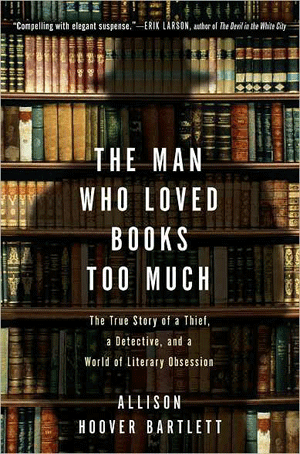
THE MAN WHO LOVED BOOKS TOO MUCH by Allison Bartlett


Although the title suggests that this book could feasibly be about me, it is not. Sue recommended this to me thinking I would like this and boy, was she on the money. I liked this book a good deal.

The book, non-fiction, is about a man, John Gilkey, with an addiction. The guy loves to steal books. For years, he would acquire rare and expensive books illegally, usually by using stolen credit card numbers. He was aided by lax law enforcement who, by and large, often couldn't care less about the theft of a book.

Someone who did, though, was Ken Sanders, the security chair of the Antiquarian Booksellers Association and a bookseller himself. Sanders took his role as security chair seriously and managed to link several book thefts of Gilkey's together. By communicating with other dealers, he managed to catch Gilkey in a sting operation which sent Gilkey to jail.

Gilkey eventually got out (even though he had been jailed many times before) and went right back to stealing or planning to steal books. Gilkey was obviously a sick individual. He had no interest in reading any of the books, choosing to acquire them because he viewed them as symbolic of something more - wealth, power, intellect. He often talked with his father of leading a better life and creating an empire of sorts for them.

Sanders, however, was a much more interesting fellow. The more I read, the more I wanted to know about him and the less I cared about Gilkey.

In the end, it didn't matter because the book turned out to be largely about the author, Bartlett. I'm not sure why this was. She spends time trying to get herself interested in collecting books so that she might have a better appreciation of why people collect and what lead Gilkey to steal. Gilkey reveals a lot of things about his thefts to her which create some moral dilemmas for her.

I liked the book even though I didn't care for Gilkey or Bartlett. If not for Sanders, though, I probably wouldn't have liked the book as much. It's a nice light true crime book that I think would be a pleasant change of pace for most readers.

--Jon

Tuesday, February 22, 2011

THIEVES OF MANHATTAN by Adam Langer


I enjoyed and hated this book, pretty much simultaneously. On the one hand, it reads like a decent adventure story. Each chapter ends with a little bit of cliffhanger which makes you want to read more. It also is an interesting piece of metafiction. This is good and bad. On the one hand, it is interesting. On the other....

The book is about a writer by the name of Ian Minot. Young guy, can't catch a break and get anything of his published. He works as a barista in New York City and dates a Romanian girl by the name of Anya who has written a memoir of her life in Romania and her trials as an orphan in the United States. Anya is asked to do a reading at a spot known for finding breakout authors. Sure enough, Anya's reading is a hit and her memoirs are sold to a publisher.

At a publishing party, they run into Blade Markham, a former gang member turned bestselling memoir writer. Blade and Ian get into a fight, Anya falls for Blade and Ian is left more depressed than ever.

A fellow turns up at Ian's coffee shop with a copy of Markham's book. Ian hurls the book down the street which results in him being fired from his job. The man with the book (known up to this point as The Confident Man (a play on confidence man, no doubt)), is impressed with Ian's hatred of Markham. Turns out the fellow, named Jed Roth, was a former editor. Roth's assistant went over his head to get Markham's book published and rather than work on it with the assistant, Roth quit. He has a plan for revenge.

Roth wrote a novel many years before called The Thief of Manhattan. It is about a writer who visits this unique library run by a fellow called "The Hooligan Librarian". Hooligan has been stealing rare books from this library and selling them to a shady appraiser for whom he used to work as a research assistant in grad school when she was part of the school's faculty. The narrator of the book discovers this when an attractive redhead wants to look at a book on display and Hooligan doesn't let her. Roth's narrator breaks into the library and takes the book to give to the redhead. Hooligan finds out, burns down the library, and he and the appraiser try to find Roth's narrator. The narrator buries the book, gets into a shootout with the bad guys and wins. Finds the girl and lives happily ever after.

Roth's novel didn't get published. He wants Ian to try and pass it off as a memoir now in order to get it published. They get the firm who Roth worked for to publish it, it is renamed The Thieves of Manhattan, and Ian becomes popular. The plan is to then expose the memoir as novel to embarrass the publishing firm.

It turns out that the memoir is not a novel but a memoir. The Hooligan and his boss begin to hunt down Ian. As he is being chased, Ian starts to record what's happening to him as a memoir. So we end up with a novel titled Theives of Manhattan, subtitled a novel a memoir, which is about a writer who publishes a book called Theives of Manhattan, passing it off as a memoir instead of a novel when it is really a memoir....sort of.

So it's exciting and sort of clever in its self-referential treatment. What didn't I like? Well, some more of the self-referential stuff. When Roth writes his T of M, he uses made up words that are authors or character names that are connected to the objects whose names he are using to represent said objects. We don't know that, though, and as we're reading Langer's T of M, which is told by Ian, we come across these same references. The first I recall is Ian saying someone has a chabon of hair. Now, when I read it, being a huge fan of Michael Chabon, I immediately pictured someone who had his hair. My reaction, though, was "Huh, I didn't know chabon was an actual word". Then people start drinking fitzgeralds. Not capitalized. How strange. Drinks with names are usually capitalized. You don't see people drinking bloody mary's or long island iced tea. Then folks start wearing gatsbys and golightlys. When someone lit up a vonnegut, I really got irritated. Finally, when we get to Roth's character, we find that Roth likes to do that and that his T of M even has a glossary for these terms. Turns out, so does Langer's T of M. I thought it was a stupid mechanism and could not see the point outside of advertising Langer's literary background.

There's more self-reference. Ian says he will dedicate his real memoir to Joseph, his former boss who ends up helping him out. Langer's book is dedicated "to J. for reasons that should become somewhat clearer sometime after page 195" which of course is the page where Ian declares his dedication intent to Joseph.

At some point it all stopped being clever and just started bothering me. I also really disliked how the book wrapped up. The ending was goofy and far-fetched.

The book also reminded me of a novel I read in 2009 about the publishing industry, How I Became a Famous Novelist. I'd call it a tossup as to which I liked more. I remember Hely's book being funnier but Langer's is more captivating. Neither, though, are something I would particularly recommend. 

--Jon

Saturday, February 19, 2011

THE GUN SELLER by Hugh Laurie


If you go back in the children's area of the library, you'll find a poster of Hugh Laurie, the actor known primarily for his title role in House but also for other acting roles, encouraging you and your kids to read.This isn't just the American Librarian Association using celebrity power for advertising. Laurie is a writer and The Gun Seller is his first novel.

I really enjoyed this book. It is sort of a spy thriller but yet, not really. The dustjacket calls it a spoof of spy thrillers though I didn't really view it as that either. The main character, Thomas Lang, is a former member of the Scots Guards who now takes on the occasional mercenary type gig to make some money. He is approached by someone wanting him to kill a businessman. Lang turns down the offer and decides it would be best to try and warn the target as well.

All good deeds go punished and Lang finds himself getting more and more entwined in a complex web of bad guys; an arms dealer, renegade government factions, a terrorist group. Why does Lang get caught up in this mess? Love. He falls in love with the daughter of the businessman he was supposed to kill and every time he seems as if he might be able to get out of the mess, thoughts of her drag him right back into it.

What I enjoyed most about this book was the language. It felt a bit like a Leslie Nielsen movie with the characters taking words too literally. Lots of sarcasm.

I didn't like how ridiculously convoluted the plot was. It felt like Laurie was trying too hard to make something special and new in the spy genre field and just went too far. I also didn't get how Lang fell in love so easily with this woman and was willing to risk his life for her when he barely spent any time with her. The ending is a happy, albeit unexpected one.

The Gun Seller is a very fun book It has flaws but they're not bad enough to ruin the enjoyment of Laurie's writing.

--Jon

Wednesday, February 16, 2011

AN OBJECT OF BEAUTY by Steve Martin


I'm a big fan of Steve Martin. More of his writings than his acting. I also like his humor and music. He's sort of an entertainment Renaissance Man. I really enjoyed his first two novels, The Pleasure of My Company and Shopgirl. Since then, though, I have been disappointed with his books Pure Drivel and, now, An Object of Beauty.

An Object of Beauty traces the life of Lacey Yeager as she makes her way through the art world during the 1990's and 2000's. The book is told by her friend who works as an art writer.

The novel starts as being about Lacey but as the book goes on, Martin spends more and more time talking about the conditions of the art world, especially in New York City. It gets to the point where the final third to half of the book almost reads more as non-fiction. In the final chapter, even, the narrator says that he may just make some changes and publish the book as non-fiction.

This is one of the reasons I didn't like it. It could have been a good novel. It could have been a good treatise on the business of art. Combined, it didn't work for me. I also didn't like how Martin portrayed Lacey. If you listed Lacey's interests in life, art would be first, sex would be second and everything else wouldn't make the list. She could have been made more admirable - woman works her way up through the male-dominated art world through skill, intelligence, charm and perseverance - but Martin's focus on Lacey's relationships with men covers up anything positive and makes her sort of sleazy (along with some other things she does). I didn't find her to be likable at all. I also didn't like the layout of the chapters. They were extremely short and did not flow into one another well in the least.

Martin is knowledgeable about art and it definitely comes through in this book. I almost wonder if he had to make it a novel because no publisher would take him seriously if he tried to do a work of non-fiction on art. It's sort of a shame because there is a lot of good stuff in the book. The book also is nice in that it shows many of the works of art that are mentioned in the story.

For me, the negatives outweighed the positives and I'm disappointed that after such a great beginning as a writer, I feel Martin has tailed off.

--Jon

Sunday, February 13, 2011

CAMERA by Jean-Philip Toussaint


I just didn't get this book. It was short and quick and entertaining but I'm here, writing this review a few days after reading the book, and I find myself having a tough time remembering anything about it. I read a lot and I'm a fairly quick reader but I also tend to retain what I read. That just didn't happen here.

When the first sentence of the book is, "It was about the same time in my life, a calm life in which ordinarily nothing happened, that two events coincided, events that, taken separately, were of hardly any interest, and that, considered together, were unfortunately not connected in any way.", well, perhaps that explains some of my not getting it. I don't think anything really happened in this book.

The narrator is a man, of an age I could not determine. He's just learning to drive, which doesn't indicate much. He goes to get his permit and finds himself infiltrating the life of the "young woman" who operates the permit office. Some sort of relationship develops, although why and how isn't real clear (which is why I used the word infiltrating). The woman's father appears in the story and makes it seem as if the narrator is about the same age as the woman (which begs the question why the narrator refers to her as "young").

I guess it is supposed to be a bit of an existentialist book (given that the back cover blurb calls Toussaint , "A comic Camus for the twenty-first century", makes sense) but I'd call it self-absorption rather than existentialist. It isn't so much life that the narrator ponders but rather specifically, HIS life. And as he says, nothing happens in his life.

There were some funny points in this and it is really short. I didn't waste a ton of time on it. Maybe it's too highbrow for me but I just didn't get it and so can't recommend it.

--Jon

Saturday, February 12, 2011

BETWEEN A ROCK AND A HARD PLACE by Aron Ralston


I loved this book! (Your suspense is over – I’m recommending it.)

Aron Ralston writes of his experience of being trapped in a slot canyon for five days with minimal water and food. An experienced climber and hiker and over-confident adventurer, he set off on an easy solo day hike and ended up knocking a boulder loose which trapped (smashed) his right hand between the boulder and the wall.

He writes about his time trapped in the canyon, how he rationed his food and water and used his climbing equipment to keep warm at night. Every morning, a slice of sunshine reached down in the chasm and warmed slightly the tip of his leg for a few minutes. He logically thought through all escape and possible rescue options before coming to the conclusion that he was going to die in the canyon. Several times during his entrapment, he videoed himself talking to his family, explaining his predicament and saying good-bye.

I won’t spoil the book for you by telling you how he manages to live. If you have heard of or have seen the movie 127 Hours, you already know something about this book, on which the film is based.

Between a Rock and a Hard Place is beautifully written, with raw emotion and a passionate description of a ridiculously unbelievable situation. Aron Ralston includes painstaking details of climbing terminology, most of which I did not understand. And he weaves into the narrative many other aspects of his life, from his family to how he gave up an engineering job to work in the climbing industry to some of his many near death experiences, like almost drowning and getting caught in an avalanche.

His fresh and meticulous writing make his story riveting. I can’t wait to see the movie and am sad to place this book back on the shelf at the library.

JJ

Thursday, February 10, 2011

HORSE RACING: FICTION


They say truth is stranger than fiction. That may be. But based on the horse racing books I've been reading recently, fiction is much more entertaining than fact.

I got started on this kick with Keith Dixon's The Art of Losing. I was fooling around with the "card catalog" at the library and decided to look for novels with the subject of gambling. In addition to 3,423 books by Dick Francis, this one came up. I requested it from one of the other branches and plowed through it.

The Art of Losing is a very dark book. One of the darker ones I've read. The main character, Michael Jacobs, is a documentary filmmaker who makes decent films but they do not generate enough interest to be profitable. This shouldn't really matter since Jacobs comes from a wealthy family who are encouraging of his occupational choice and who like his movies. Nonetheless, Jacobs cannot bring himself to rely on assistance from his folks.

Jacobs' friend and producer, Sebby Laslo, has a problem with gambling. He has indebted himself too much with the wrong kinds of people and comes to Mike with a broken thumb received from a fellow he owes money to and a pitch for how to get them both on track.

Sebby has a friend who is a jockey. The plan is to get another jockey involved and have the two jockeys conspire to fix a race on which Sebby and Jacobs have wagered heavily. In order to do this, though, and get the kind of odds they want, they have to place the wager with an illegal bookmaker. In order to get a bookmaker (or multiple bookmakers) to give them odds on a big bet like that, they have to establish that they are chumps and so have to lose a bunch of money in advance, money neither of them has.

If this doesn't bode well to you in my review, well, that foreboding feeling isn't going away if you read the book either. Dixon does not create an inspiring atmosphere. You have a sense that those best laid plans are certainly going to go awry.

Even with the bad vibe, the book moves you along. There is a glimmer of hope....maybe...or maybe it's the sense that you're about to view a train wreck. Something keeps you moving ahead with the book. And it's good. Surprisingly good given that I picked it solely based on a card catalog subject heading. Just don't go reading it on a day where you could use some optimism.

Likewise, I felt like I had to shower every time I put down Lord of Misrule. The 2010 National Book Award winner for fiction, it takes place at a podunk race track in West Virginia, the absolute bottom rung of thoroughbred horse racing. Every chapter is told from the perspective of one member of a motley crew of characters. The way author Jaimy Gordon writes, though, it often takes a few paragraphs to figure out just who is telling the story this time. The book is divided into four sections, each of them relating to a horse that intertwines all the characters.

The book is about all of the characters and none of them. They range from those struggling to eke out an existence to those trying to maintain their status as a big fish in a teeny-tiny pond. A puddle, if you will. The horses at this level aren't Secretariat. At best, they're Secretariat after he's gone infertile, suffered through injuries and can hardly run anymore.

I've always been fascinated by the lower levels of horse racing where the purses are such that owners almost have to win just to cover their expenses. I often have wondered about the people involved with these races; the track operators, the jockeys, the trainers. Gordon gives one possibility of those types of people. You have people who race at that level because they love racing. There are those do it because they don't know what else to do. Some have had bad luck.

Like The Art of Losing, you never shake that foreboding feeling. There are a number of outright bad guys and their presence, coupled with the conditions at the track, left me feeling dirty. That says a lot about Gordon's writing as much as anything. She doesn't quite use dialects but she captures the rural, uneducated essence of most of the characters.

Much more so than Dixon's book, this book is for readers who appreciate good fiction, regardless of an interest in horse racing. I'm not sure Dixon has the universal appeal. And although Gordon's story has a slightly happier ending, the overall darkness and the difficulties keeping the characters straight make it less than perfect. It's still great and worth reading.

--Jon

Monday, February 7, 2011

PRICELESS by William Poundstone


It's not often that a book leaves me feeling dumb. This book did. Subtitled "The Myth of Fair Value (and How to Take Advantage of it)", it talks about how completely irrational we humans are when it comes to price.

Having a background in statistics, I like to think I understand numbers and can't be duped by pricing schemes. I'll make a purchase sometimes and think I'm getting a great bargain and that it was I that duped the retailer. That's just what they want you to think.

The book is a summary of various psychological and economic studies that show how irrational human beings are.

For example, from page 146:
"Imagine that you are about to purchase a jacket for $125 and a calculator for $15. The calculator salesman informs you that the calculator you wish to buy is on sale for $10 at the other branch of the store, located 20 minutes' drive away. Would you make the trip to the other store?"

Most respondents said yes. In another study, the prices were reversed and the calculator cost $125 but was on sale for $120 at another store. The jacket was $15. Still a total of $140 being spent at Store A, $135 at Store B but this time most respondents would not travel to the other store. Even though five bucks would be saved either way, the respondents felt that it was worth making the trip for a 33% savings but not for a 2.5% savings.

Or how about this one? Students had to choose between two tasks. Either recall and write down a failure in their lives while eating a 15 gram piece of chocolate or recall and write down a success in their lives while eating a 5 gram piece of the same brand of chocolate. Most chose doing the negative task with the big chocolate. After the assignment was completed, the students were asked to rate their experience on a nine-point scale from extremely unhappy to extremely happy. Those who wrote about the success were happier.

As you can probably determine, the experiment was considered "a microcosm of life". We think the bigger piece of chocolate (or more money or more stuff) will bring us happiness when it's really what we do and how we lead our lives that brings true happiness.

Some of these studies I had read about before, either as statistical experiments or in other articles or books (such as Dan Ariely's book Predictably Irrational or Levitt and Dubner's Freakonomics. Even still, I was educated and learned a lot. The downside of the book (outside of glimpsing my own irrationality) was that many of the experiments were glossed over, omitting details I would've thought useful. With 57 chapters over 288 pages, you're only looking at about five pages an experiment. I think some could have been omitted and others expanded.

Definitely a good read, though, and a must read if you like hanging out in the 330 section of the Dewey Decimal system.

--Jon

Friday, February 4, 2011

HORSE RACING: FACT


I'm on a bit of a horse racing kick right now, some fiction, some not. After reading a novel I'll review later, I decided I wanted to read about a jockey. The pickings are slim in our system and I opted for Yankee Doodle Dandy, about Tod Sloan. I felt good about this pick because within an hour after putting in the request for it, I checked Baseball-Reference's This Day In History section and there, on that very day, was something about jockey Tod Sloan buying a billiards parlor with New York Giants manager John McGraw. I figured if he was a business partner of McGraw's, he has to be an interesting fellow.

After reading the book, it's hard to say. Despite being touted as a biography on Tod Sloan, the majority of it is a history of horse racing through the end of the 19th Century. I think the author did this to flesh out the book since there wasn't a whole lot of source material on Sloan.

Sloan was most noted for supposedly being the fellow who popularized the current style of riding a racehorse; leaning forward and being up around the neck and head. Before Sloan, riders sat upright back in the saddle and rode like you see in Westerns.

Most of Sloan's success came abroad, even serving as the jockey for Edward, Prince of Wales's entry in the Epsom Derby. His success was rather short, though, as the British Jockey Club accused him of taking money from owners as gifts and wagering on races. He was banned from racing in England and the ban was enforced in America as well ending Sloan's career.

Sloan was such a popular figure that George Cohan wrote a musical, Little Johnny Jones, that was based on Sloan. This is the musical that gave the world the songs "Yankee Doodle Boy" and "Give My Regards to Broadway".

I found the book somewhat interesting but wish it had been honest in it's title. It's really only the last couple of chapters that deal significantly with Sloan. There's one chapter in which Sloan merits only a single paragraph. What bugged me the most about the book was the lack of citations and how it tied in to Dizikes' writing and research. I thought Dizikes' writing was pretty bland and a large amount of his writing is cobbling together fragments of sentences from newspapers. He then sometimes cites them (citations were really haphzard) in clusters in the endnotes. So you'll read a paragraph which contains four or five quotes of a few words apiece, turn to see from where they came, and just find a list of newspapers with no indication of what came from where. I thought it was really lackadaisical and unprofessional, especially from a college professor who also has won the National Book Critics Circle Award. While not an awful book, it annoyed me enough not to recommend it.

I then read Timothy Capps' biography on the horse Secretariat. It is part of the Thoroughbred Legends series that Eclipse Press put out. Unfortunately, the library system does not have any of the books in this series. These are really handsome books. I actually feel that the dustjacket detracts from the overall quality of the book. While the dustjacket is understated, the book itself contains the sepia-toned photo shown on the dustjacket on the cover which is a lovely red with a gold-embossed title and spine. Add a built-in ribbon bookmarker and it's a nice book. Sadly, they reissued the series of 24 books in softcover. I miss the days when books could be works of art. While I wouldn't go that far with this, it is mighty nice.

But books are for reading, and this was an OK read. The book has small dimensions and large margins which makes for a small amount of text for a 220+ page book. And it is about a horse so the content isn't dazzling. Secretariat was an amazing horse, one of a handful that transcended the sport. Mention the name and even non-racing fans know something. But still, what can you write about a horse?

Well, the author begins by talking about the farm on which Secretariat was eventually born and raised. He then goes into a chapter which reads like the beginning of the Book of Matthew ("Abraham begat Isaac; and Isaac begat Jacob; and Jacob begat Judas and his brethren") only with horses. Then we get into Secretariat's career. This portion is the most interesting and Capps reports the races very nicely and discusses some of the rival horses that Secretariat faced.

Rival might be a bit strong of a word. The only time Secretariat finished outside of the top three in a race was his first race, where he finished fourth. The only time he was not the favorite in a race, he went off at 3-2 odds.

Of course, nothing demonstrated the lack of a rivalry better than Secretariat's romp at the Belmont Stakes:


Secretariat was retired after his three-year old season. The book talks about his career at stud and the relative lackluster nature of that career and then ends in a really goofy way with a fantasy race call between Secretariat and Man O'War. Lame way to end.

Not a bad book but not good either. It referenced Bill Nack's biography of Secretariat a couple of times, a book I own but have not read. Maybe sometime in the near future. The link I provided is to the newest reissue of the biography which the library system has. It was reissued in conjunction with the movie Secretariat.

Ah, yes, the movie. We just got that in at Strasburg and so I had to watch it. Didn't like it one bit. The movie was hardly about Secretariat but rather focused on his owner, Penny Chenery Tweedy. Instead of being about one of the greatest racehorses ever, the movie was about a woman succeeding in a man's world. That's fine, especially if you don't mind the Disnifying of facts, but then call it what it is. Secretariat was more a piece of scenery than he was the focus of the movie. I thought John Malkovich was entertaining as trainer Lucien Laurin. Otherwise there was little about the movie I liked. If you want to watch a better Disnified horse racing movie, I'd recommend Seabiscuit. Better story, better acting, better racing scenes, better everything.

--Jon